Pension savings funds are an essential tax-saving financial product for South Korean office workers, allowing them to prepare for retirement while simultaneously securing year-end tax refunds. In the past, these were primarily simple savings accounts opened at banks, but recently, they have evolved into performance-based investment vehicles where investors can allocate funds to various index funds, thematic ETFs, and active funds through securities firms. For instance, Mr. Kim, who joined the workforce last year, deducts a fixed amount from his monthly salary to systematically accumulate shares in a US semiconductor-related ETF. As a result, he can reinvest the monthly dividends without immediately paying taxes, fully benefiting from the power of compound interest. Today, we will examine specific strategies for maximizing tax savings and growing retirement assets through pension savings funds. This article is packed with practical information, from account opening to product selection, so please read on to the end.
=
A Comprehensive Guide to Pension Savings Fund Tax Deduction Limits and US Stock ETF Investment Strategies
1. What is a Pension Savings Fund?
A pension savings fund is a representative tax-qualified pension account opened at a securities firm, allowing investors to freely invest in stocks, bonds, ETFs, and other assets. Unlike pension savings trusts or insurance products previously offered by banks and insurance companies, the key difference is that investors can directly select their own investment instruments. For example, while bank products offered principal protection, their returns barely kept pace with inflation. In contrast, this account allows you to hold stocks of high-growth global companies. Mr. Lee, an office worker, followed a colleague’s advice to cancel his existing insurance policy and transfer his account to a securities firm. As a result, he now proactively manages his retirement assets by adjusting the allocation between US tech ETFs and domestic dividend ETFs. The ability to flexibly respond to market conditions rather than simply letting assets sit idle is why this account is highly regarded in the modern wealth management market. Another significant advantage is the tax deferral benefit, which postpones taxation on investment gains until the pension is actually received. In a regular securities account, profits from overseas equity ETFs are subject to immediate interest or dividend income tax. However, in a pension savings fund, this is not necessary. Since the money that would have been paid in taxes remains in the account to continue compounding, the gap in asset growth speed becomes enormous over time.
A pension savings fund allows investors to directly invest in promising assets and maximize compound interest through tax deferral benefits.
2. Tax Deduction Limits and Tax-Saving Benefits
Every year during the year-end tax settlement season, the top keyword for office workers is tax deduction benefits. A pension savings account offers a tax deduction of up to 6 million KRW on its own, and this limit increases to a maximum of 9 million KRW when combined with an Individual Pension Account (IRA). Employees with a total annual income of 55 million KRW or less are eligible for a 16.5% deduction rate, allowing them to receive a substantial refund of up to 1,485,000 KRW. Even for those with higher incomes, a 13.2% deduction rate applies, enabling a refund of up to 1,188,000 KRW, making it a loss to ignore. Mr. Park, a young professional, was surprised to receive a large refund notice last year because he had not paid much attention to this account. He wisely reinvested the refunded amount into the account to serve as principal for the following year’s investments. However, it is important to note that rather than forcing a large lump-sum deposit at year-end to meet the deduction limit, it is more advantageous to make regular monthly contributions. Consistent systematic investing allows for cost averaging, buying fewer shares when prices are high and more when they are low. This also naturally prevents a sudden strain on living expenses, which is beneficial for mental well-being.
You can receive a tax deduction of up to 9 million KRW annually by combining pension savings and an Individual Pension Account, with refund rates ranging from 13.2% to 16.5%.
3. What Assets Should You Hold?
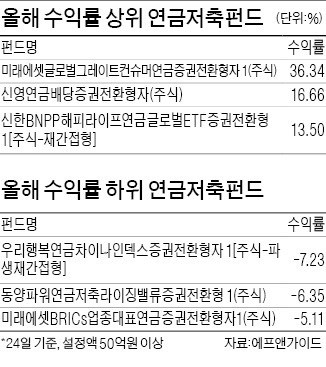
Within a pension savings fund account, you can freely trade domestic and international equity ETFs, bond ETFs, and various thematic products. Recently, products tracking US semiconductor or artificial intelligence indices have gained popularity, leading to an explosive influx of young investors. For example, Samsung Asset Management’s US Semiconductor ETF can be traded not only in regular securities accounts but also in these pension accounts. Mr. Choi, an office worker, allocates half of his monthly contributions to safe domestic bond products and the other half to US broad-market index trackers. By diversifying assets in this way, he can maintain composure and continue long-term investing even when the stock market experiences significant volatility. Conversely, it is crucial to remember that principal-guaranteed products, such as regular bank deposits, cannot be held in this account by principle. For successful investing, rather than chasing trends and constantly changing stocks, you should select long-term growth assets that align with your retirement timeline and investment style. The Default Option system is also well-established, so if you find it difficult to select stocks yourself, utilizing Target Date Funds (TDFs) designed by experts is a good alternative.
Pension savings funds can hold US semiconductor or global index-tracking ETFs, but principal-guaranteed products cannot be held directly.
4. The Magic of Dividend Reinvestment
Investing in ETFs often brings the small joy of seeing your account balance grow steadily due to periodic distributions. In a regular account, a 15.4% dividend income tax is strictly deducted from each distribution, which gradually weakens the power of compound interest. However, distributions generated within a pension savings fund account are reinvested in full without any tax deduction. Mr. Jung, an office worker, had a major realization when he saw that the distributions from his dividend growth ETF were being reinvested without tax deductions. Because the money that would have gone to taxes is used to buy more shares, the speed at which his assets grow has become noticeably faster. This small difference compounds over long periods of 10 or 20 years, resulting in a massive gap in returns of tens of millions of won. The true value of this account is also realized when receiving the pension after retirement, as it is often excluded from the general financial income comprehensive taxation. If the annual pension receipt does not exceed 15 million KRW, you benefit from a low-rate separate taxation, with tax rates ranging from only 3.3% to 5.5%. This means you do not have to lose sleep worrying about a tax bomb, making it the strongest shield protecting your retirement.
Distributions from the account are reinvested without tax deductions, maximizing compound interest, and you receive low-rate taxation benefits upon receipt.
5. Cautions Regarding Early Termination
Pension savings funds offer numerous tax-saving benefits, but to fully enjoy them, you must strictly adhere to the conditions set by the state for a long period. If you terminate the account early before the age of 55 or before completing the required holding period, or if you withdraw funds in a form other than a pension, you will face severe penalties. You must return the tax deductions previously received, and a high tax rate of 16.5% is imposed on investment gains as miscellaneous income tax. Mrs. Han, a housewife, once regretted this greatly when she carelessly terminated her husband’s pension account a few years ago because she urgently needed cash, resulting in a massive tax bill. While the principal portion that did not receive tax deductions can be withdrawn without tax, the deducted amounts and investment gains must be paid in full as taxes, so caution is required. Therefore, the money deposited in this account should not be emergency funds needed for next year, but rather surplus funds that can be locked away for at least 10 years. If you urgently need cash due to unavoidable circumstances, it is wiser to explore the pension collateral loan system offered by financial institutions rather than terminating the account entirely. This allows you to borrow funds at low interest rates within a certain limit without selling your assets, thereby avoiding tax penalties.
Early termination requires returning tax deductions and incurs high miscellaneous income tax, so it should only be managed with funds intended for long-term holding of at least 10 years.
6. Advice for Successful Retirement Preparation
So far, we have carefully examined the basic concepts of pension savings funds, tax deduction limits, recommended products, and points to note. If you wait until retirement is imminent to start preparing, you will likely miss the optimal timing. Open your securities firm’s app today, open an account in your name, and start accumulating promising ETFs with the money saved from a few cups of coffee each month. Mr. Kang, an office worker, confidently states that he is no longer afraid of life after retirement because he has consistently deposited 300,000 KRW into this account every month since his early 30s. Just as a mountain is built from grains of sand, the small habit of systematic monthly investing will create a miracle, providing a steady cash flow in your old age. Time is passing even now, and the best time to enjoy the magic of compound interest is today. I sincerely hope you will move one step ahead of others, save on taxes, and become a wise investor who pioneers a prosperous future. Do not forget that a stable life in the future is not a coincidence but the cumulative result of the small financial decisions we make today.
Retirement preparation must start immediately, and consistent systematic investing can complete a prosperous cash flow after retirement.
Frequently Asked Questions
=