The method of receiving your retirement pension—whether as a lump sum or as monthly pension payments—can dramatically change the amount of money you actually take home, with differences ranging from a few million to tens of millions of won. Last year, Mr. Kim, a 50-year-old office worker who recently retired, chose the lump sum option without much thought and ended up facing a massive tax bill, leading to deep regret. In contrast, Mr. Park, who meticulously planned a tax-saving strategy, significantly reduced his tax burden by using a pension account and secured a stable monthly living expense. Understanding the system accurately is essential to making a wise decision at this critical crossroads that everyone faces once they turn 55. In this article, we will thoroughly examine the characteristics of different types of retirement pensions, the tax differences between lump sum and pension payouts, and the key criteria for making the most advantageous choice for you. Instead of complex financial jargon, we will use everyday examples to explain things clearly, so please read through carefully to the end.
=
A Complete Guide to Comparing Lump Sum vs. Pension Payouts and Taxes for Retirement Pensions
1. Types of Retirement Pensions and Basic Understanding
Retirement pensions are broadly divided into Defined Benefit (DB) plans, Defined Contribution (DC) plans, and Individual Retirement Pensions (IRP), each showing significant differences in management and payout methods. In a DB plan, the company directly manages the funds and determines the amount you will receive upon retirement in advance, which means employees bear less burden regarding asset management. On the other hand, in a DC plan, the company deposits a fixed amount into your account every year, and the employee directly selects and manages financial products, making personal investment tendencies crucial. If losses occur while managing a DC account, the final retirement payout may decrease, so special attention and management are required. Upon resignation, the money does not go directly into your regular salary account; by law, it must be transferred to an Individual Retirement Pension account for safekeeping. This IRP account serves as a dedicated fund for old age, and by law, you are generally eligible to receive funds only after turning 55. Therefore, as retirement approaches, the first step is to accurately identify the type of product you are enrolled in and check the balance and conditions with your financial institution in advance.
Retirement pensions are divided into DB, DC, and IRP plans, and upon retirement, they are transferred to and managed in an Individual Retirement Pension account.
2. The Decisive Difference Between Lump Sum and Pension Payouts
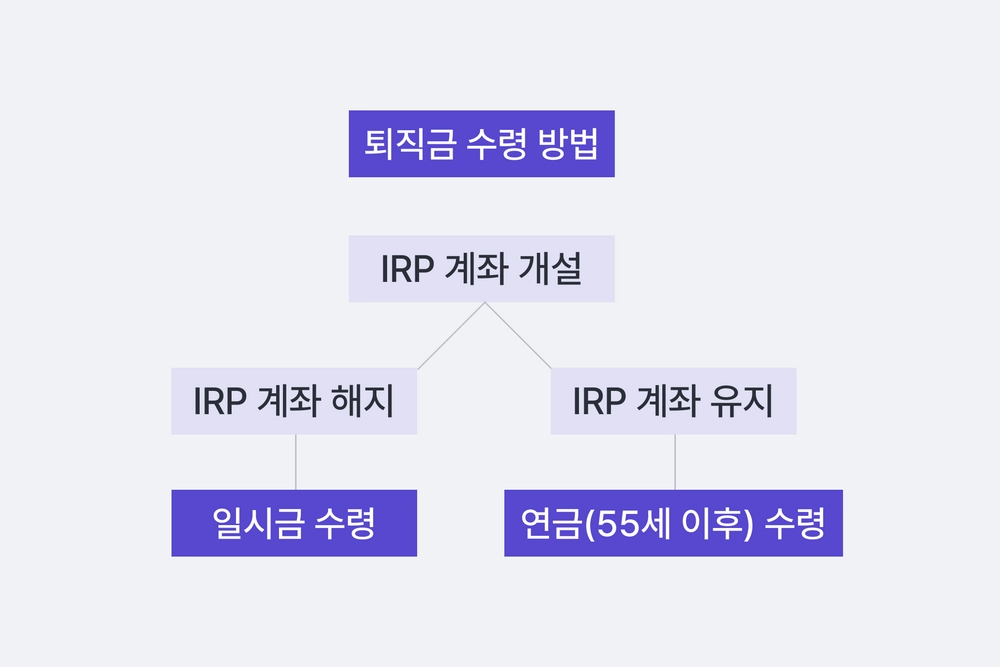
Receiving your retirement pension as a lump sum has the advantage of providing a large amount of cash immediately, which is very convenient for uses such as purchasing a home or funding a business. However, because a large sum is received at once, the retirement income tax rate is applied all at once, making it highly likely to result in a significant tax burden. In reality, if you receive 100 million won in retirement benefits as a lump sum, a substantial amount of tax is incurred, resulting in a much smaller amount actually deposited into your bank account than expected. On the other hand, if you leave this money in your Individual Retirement Pension account after age 55 and receive it as a pension over a period of more than 10 years, the tax burden is drastically reduced. According to tax law revisions, if the actual pension receipt period is 10 years or less, you only pay 70% of the original retirement income tax, and if it exceeds 10 years, you receive even greater tax relief. Receiving a fixed amount regularly each month prevents the risk of spending a large sum all at once and creates a stable cash flow until the end of your life.
Lump sums are advantageous when you need a large amount of cash immediately but carry a heavy tax burden, while pension payouts reduce taxes and secure stable monthly living expenses.
3. Strategies to Maximize Tax Benefits for Pension Payouts

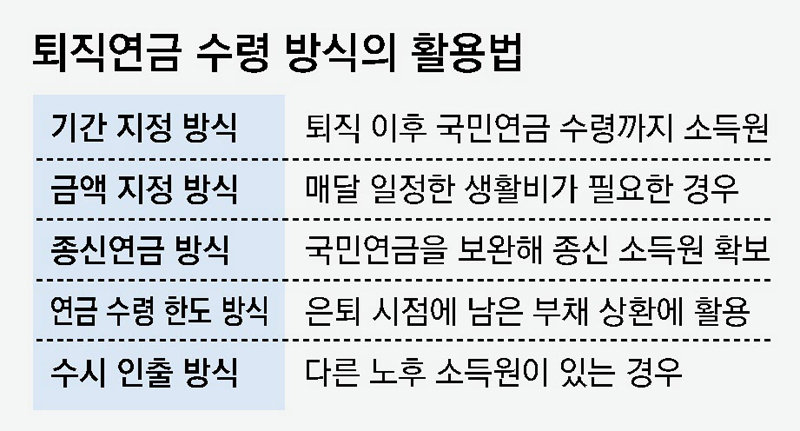
When choosing to receive a pension, the most important thing is to accurately understand the pension receipt limits and duration calculations and to withdraw money planfully each year. If you withdraw too much as a pension at once, you may be subject to excessive taxes instead of the standard pension income tax, so you should actively utilize the tax consulting services provided by financial institutions. For example, if you divide 100 million won in retirement funds over a period of more than 10 years, the perceived burden of annual taxes is noticeably reduced. To fully enjoy the tax incentives encouraged by the government, you need the wisdom to spread out the receipts over a long period according to annual limits rather than using it all up quickly. Another huge advantage is that income generated from managing products within the pension account is not taxed immediately; taxation is deferred until you receive it as a pension. This allows you to maximize the compound interest effect, so it is required to manage your return rate consistently and not leave the account neglected after retirement.
By setting the pension receipt period to more than 10 years and utilizing the tax deferral effect, you can minimize the tax burden while growing your assets.
4. Procedures and Precautions for Applying for Retirement Pension Payouts
To officially start receiving your retirement pension, you must first confirm that your company has completed the retirement processing and that your retirement benefits have been deposited into your Individual Retirement Pension account. Once the transfer is complete, you can fill out and submit a pension payment application by visiting the financial institution’s branch or using their mobile app. Since the time it takes to cash out may vary depending on the type of product you were managing, it is safe to coordinate the schedule in advance. Carefully check if the money is coming in smoothly according to the scheduled retirement benefit payment date, and if there are losses due to stock market declines or bond price fluctuations, you should adjust the timing of your sales. In particular, processing at financial institutions may be delayed during long holidays such as Chuseok or the New Year, so it is a good habit to apply in advance with some buffer time. If operating mobile devices is difficult, it is recommended to visit a nearby bank or securities company counter and receive guidance from a staff member to ensure accurate processing.
After retirement processing is complete, confirm the transfer to your Individual Retirement Pension account and proceed with the payout application leisurely through the financial institution’s app or counter.
5. Tailored Advice for Retirees in Their 50s
As people enter their 50s, many worry about whether it is still meaningful to prepare for the upcoming age-55 pension receipt period. However, the 50s are the golden time to fill the tax deduction limits during the remaining tenure and restructure your asset portfolio to turn around your retirement funds. You should increase your annual contributions to fully take advantage of tax deduction benefits and appropriately allocate the ratio of safe assets to risky assets according to your age. When investing in domestic equity index funds or various financial products within your retirement pension account, you must remember that the tax system differs from that of a general account. A strategy that lowers the tax burden during pension receipt while simultaneously capturing investment returns determines the quality of life after retirement. As the saying goes, “The time you think is too late is the fastest time,” so start now by checking the balance and product composition of your account and seeking expert advice.
Even in your 50s, you can complete a solid retirement fund for the remaining period by utilizing tax deduction benefits and asset allocation strategies.
6. Outlook for Utilizing Retirement Pensions for a Successful Old Age
The future retirement pension system will continue to develop and expand convenient systems like default options, allowing participants to manage their assets more actively. The era of simply leaving the money deposited by the company untouched is over; the balance in your account after retirement depends on how much interest and active management you put in. Creating a pension flow that comes in regularly like a salary every month is the most reliable support for a peaceful retirement life. Start by taking the small step of turning on your smartphone right now to check the balance and managed products in your retirement pension account. If there are any unclear parts, do not hesitate to contact your financial institution for consultation and create your own tailored pension receipt plan. Thorough preparation and a wise choice of payout method are the only keys to making life after retirement comfortable and abundant.
You can complete a stable cash flow for old age through active asset management and thorough payout planning.
Frequently Asked Questions
=