When it comes to methods for receiving your retirement pension, opting for a pension payout rather than a lump sum significantly reduces your tax burden, making it a far more advantageous choice. Many employees choose to receive their severance pay as a lump sum to pay off housing loans or buy a new car. However, to weather the income gap after retirement, you should seriously consider the pension payout method. Upon leaving your company, first verify whether your retirement plan is a Defined Benefit (DB) or Defined Contribution (DC) type, and then proceed with transferring the funds to an Individual Retirement Pension (IRP) account in your name. If you skip this process and simply take the lump sum, you will have to pay the full severance income tax, resulting in a loss of valuable funds. In this article, we will examine in detail the payout methods for different types of retirement pensions, which often confuse employees, along with practical tips for saving on taxes. Let’s explore a smart asset management strategy that will firmly support your life after retirement.
=
Complete Guide to Receiving Your Retirement Pension: How to Save on Taxes with IRP and Receive It as a Pension
1. Identifying Your Retirement Pension Type
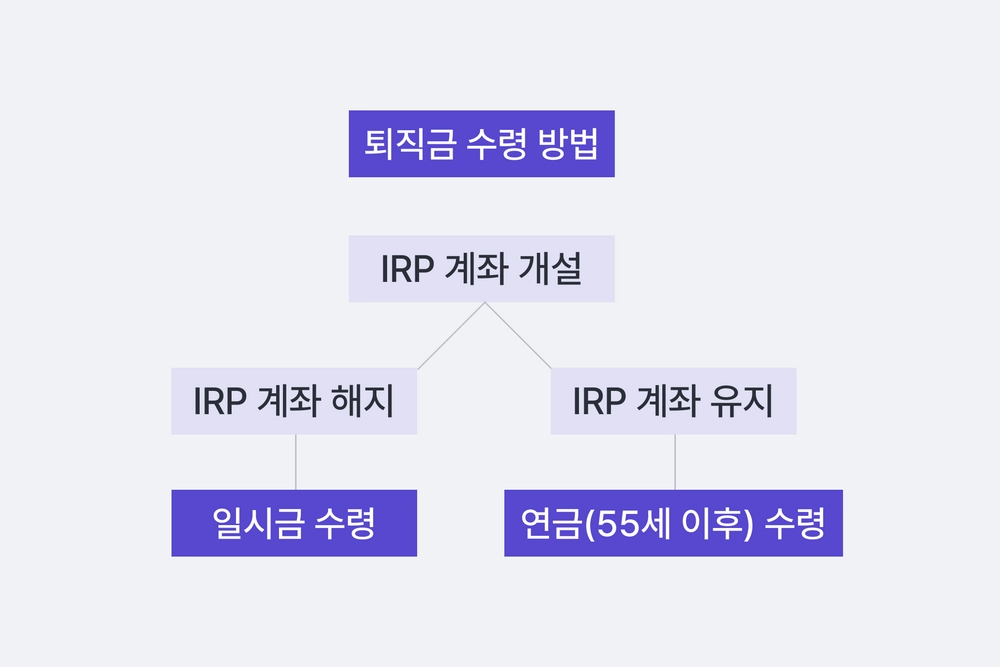
To properly plan your retirement pension payout, you must first accurately determine whether the plan you are enrolled in at your current company is a Defined Benefit (DB) or a Defined Contribution (DC) type. A DB plan is a system where the company directly manages the funds and pays a predetermined severance amount upon retirement, offering the advantage of less investment risk for the employee. On the other hand, a DC plan involves the company making regular contributions each year, while the employee directly selects and manages assets such as stocks or bonds, meaning the final payout amount varies based on investment performance. Regardless of the plan type, all funds must be transferred to an Individual Retirement Pension (IRP) account in your name at the moment of retirement for the standard pension receipt process to begin. If you have not set up this account in advance, it is advisable to visit a securities firm or bank just before your retirement to open one quickly via non-face-to-face channels. Even if colleagues around you took lump sums and paid high taxes, you need the wisdom to use a pension account to spread out your tax liability. You can only formulate an appropriate payout plan once you clearly understand the type of your retirement pension system. If you are changing jobs or approaching retirement, be sure to check your enrollment details through financial company apps or the Integrated Pension Portal.
The first step in receiving your retirement pension is to understand your plan type and prepare an Individual Retirement Pension (IRP) account.
2. Differences Between Lump Sum and Pension Payouts
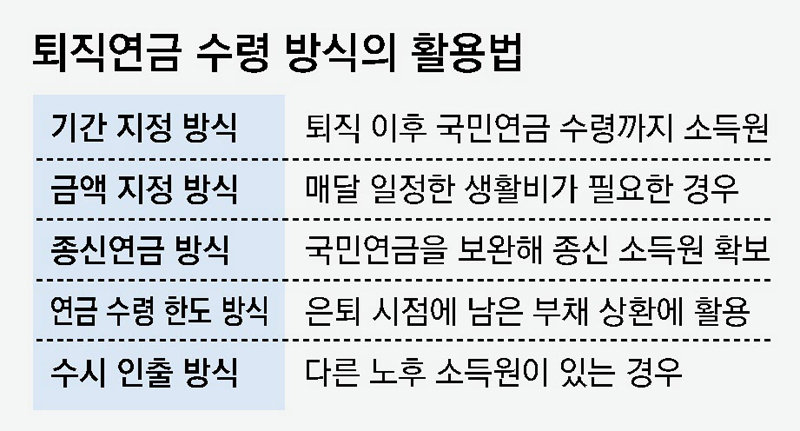
When choosing a method to receive your retirement pension, deciding whether to take a lump sum or receive it as a monthly pension is central to your post-retirement finances. Receiving your severance pay as a lump sum puts a large amount of cash in your hands immediately, which is convenient for purchasing a home or funding a business, but it is disadvantageous in terms of tax deduction benefits. Conversely, if you receive the funds as a pension over a period of 10 years or more starting from age 55, you can receive a reduction of 30% to a maximum of 40% on your severance income tax, resulting in significant tax savings. In fact, the difference in taxes incurred when withdrawing 100 million won as a lump sum versus distributing it as a monthly pension can reach several million won. It is wise to set an appropriate payout period by considering your expected fixed expenses after retirement and the timing of your National Pension benefits. Having a stable cash flow deposited into your account each month can greatly reduce the psychological anxiety caused by insufficient living expenses after retirement. Unless you urgently need a large sum of cash, we strongly recommend the pension payout method, which offers both tax benefits and a stable source of living expenses. You must carefully consider your retirement period and life expectancy to design an optimal payout period for a successful retirement.
Pension payouts significantly reduce taxes compared to lump sums and create a stable cash flow.
3. How to Utilize an Individual Retirement Pension (IRP) Account

The Individual Retirement Pension (IRP) account plays the most critical role in retirement pension payouts, serving as an essential tool for securing both tax deductions and asset management. Employees can also receive tax deduction benefits on additional annual contributions, making it a staple item for year-end tax settlements. After transferring your severance pay to this account, you can aim for additional returns during your retirement period by appropriately adjusting the ratio between safe and risky assets. Recently, with the proliferation of financial platforms allowing direct investment in various Exchange-Traded Funds (ETFs) and bond products, more people are expecting returns higher than deposit interest rates. However, you must adhere to the investment limits for risky assets, as losses can affect your final payout amount; therefore, overly aggressive management should be avoided. As retirement approaches, a safe strategy is to increase the proportion of principal-guaranteed products or safe bonds to steadily protect your assets. An IRP account is not merely a place to store money but a core space for growing your retirement assets and saving on taxes. You need to regularly review your asset management status and adjust your portfolio according to market conditions.
The IRP account is the center of retirement assets, addressing both tax benefits and asset management simultaneously.
4. Understanding Severance Income Tax and Pension Income Tax
When considering how to receive your retirement pension, failing to accurately understand the tax structure can lead to paying more tax than expected, causing confusion. When receiving a lump sum, a separate severance income tax is applied rather than the general comprehensive income tax rate, and the deduction benefits increase with longer years of service. On the other hand, if you receive your severance pay as a pension, 30% of the severance income tax that would originally be imposed is reduced, and this reduction rate increases to 40% if received over a period of 10 years or more. Additionally, depending on the timing of pension receipt and the subscriber’s age, the actual applicable pension income tax rate is lowered to between 3.3% and 5.5%, significantly reducing the tax burden. If the tax calculation method seems complex, it is a good idea to use pension calculators provided by banks or securities firms to simulate the expected tax amount in advance. The core of managing retirement funds lies not only in generating high returns but also in strictly preventing money from leaking out through taxes. By effectively utilizing the subtle differences in the tax system, you can increase your actual disposable income after retirement by several million won. It is also a good method to consult with an expert about the most advantageous payout method for you, referring to the tax-saving guides provided by financial companies.
Receiving your pension in installments reduces severance income tax by up to 40%, significantly lowering the tax burden.
5. Application Procedures and Precautions
If you have decided to proceed with a retirement pension payout, you must familiarize yourself with the specific application procedures for actually receiving the money after leaving your company. Once the company transfers the severance pay to a Defined Contribution (DC) account or an Individual Retirement Pension (IRP) account, the employee applies for the start of pension payments by visiting the financial institution’s branch or using a mobile app. In addition to an ID and a copy of your bankbook, you may need documents such as a severance income tax withholding receipt, so it is safer to confirm with the customer service center in advance. In particular, the time required for cashing out varies depending on the type of managed product, so you should allow ample time during periods like the Chuseok holiday or year-end. If your portfolio includes equity funds or Exchange-Traded Funds (ETFs), you should submit your application documents with plenty of margin, considering the time it takes for sell orders to be executed. Occasionally, payment dates may be delayed due to missing documents or identity verification errors, so it is desirable to initiate the process immediately after retirement. If you prefer to avoid complex procedures, it is much more convenient to receive one-stop service from a dedicated pension consultant at your main financial institution. It is important to develop the habit of checking carefully, as minor document errors can delay fund receipt and disrupt your living expense plans.
When applying for the start of pension payments at a financial institution after retirement, you should check the product selling schedule and required documents in advance.
6. Pension Design for a Successful Retirement
The method of receiving your retirement pension is not just a technique for withdrawing money, but a crucial part of life planning that determines the financial health of your remaining years. You must combine the National Pension, personal pensions, and retirement pensions to complete the so-called “three-tier pension system” to maintain a stable cash flow after retirement. Only when a fixed monthly income is secured can you enjoy a comfortable life even in the face of sudden medical expenses or inflationary pressures. Rather than cashing out all your money as a lump sum due to rumors or impatience, you should exercise the wisdom of looking long-term and receiving payments in installments. Even now, the abundance of your retirement can change completely depending on how you manage and receive your retirement assets. Based on what you have learned today, please review your pension account once more and steadily prepare for a secure future. Those who systematically manage their pension assets to match the coming era of longevity can enjoy economic freedom even after retirement. To ensure a retirement that remains unshaken despite an uncertain economic environment, open your retirement pension account right now and start making a plan.
Retirement pensions are a core pillar for building a lifelong income pipeline when linked with the National Pension and personal pensions.
Frequently Asked Questions
=