To accurately check your vehicle tax payment details, you must use the Ministry of the Interior and Safety’s WeTax or the Seoul Metropolitan Government’s local tax electronic payment system, rather than the National Tax Service’s HomeTax. I still remember the close call I had when I forgot the schedule and nearly incurred a surcharge; it is easy to get into trouble if you don’t keep track of these matters in advance. While national taxes are handled through HomeTax, local taxes such as property tax and vehicle tax must be managed via WeTax or the Seoul local tax portal. This is especially true if you own multiple vehicles or have complex ownership structures; it is much more convenient to distinguish the details for each vehicle and note down the amounts separately. In this post, I will provide a detailed guide on how to easily check vehicle tax payments, payment deadlines, and how to apply for refunds.
=
How to Check Vehicle Tax Payments and Verify Local Taxes via WeTax: A Complete Guide
1. Understanding the Difference Between National and Local Taxes
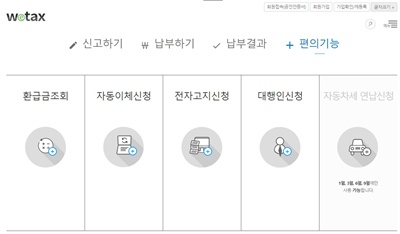
If you do not understand the basic distinction that national taxes are handled on HomeTax and local taxes on WeTax, you will likely face significant confusion starting from the tax inquiry stage. In fact, I often see people struggling for a long time trying to find vehicle tax on the screen used for checking national taxes like VAT or income tax. Since vehicle tax is a typical local tax, you must visit the Ministry of the Interior and Safety’s WeTax or the electronic payment portal of your local government to perform a correct inquiry. Even on smartphones, you need to access the dedicated local tax mobile screen rather than the National Tax Service’s mobile interface to ensure smooth processing. Clearly understanding the jurisdiction of each tax type helps prevent unnecessary time wastage. For novice drivers paying taxes for the first time, it is advisable to develop the habit of first determining whether the tax you owe is national or local. Vehicle-related taxes are fundamentally paid to local governments, so they operate separately from the general national tax administrative network. There may be slight differences in assessment methods or notice issuance timing depending on the local government, so it is safer to check the standards of your specific region. Once you know the correct inquiry path for each tax type, you can calmly handle the annual payment periods without panic. Going forward, try to develop the eye to first check which agency issued the tax notice whenever you receive one.
Vehicle tax is a local tax, not a national tax, so you must check it via WeTax or the local government’s electronic payment system.
2. How to Check Vehicle Tax Payments Using WeTax

Once you log in to the WeTax screen and complete identity verification, you can view all your current local tax details at a glance. After logging in via simple authentication or a common certificate, navigate to the local tax inquiry menu to directly select the vehicle tax assessed to you. It is very convenient because you can immediately check for delinquency or assessed amounts across all relevant national services by simply entering your license plate number. If you own multiple vehicles, it is best to carefully distinguish the details for each vehicle displayed on the screen and note down the payment amounts separately. You should carefully check the inquiry period and payment status to ensure there are no unpaid amounts. For instance, a friend of mine, who had two vehicles registered under different names, nearly missed a notice for one of them but was able to catch it early by checking each vehicle individually on the WeTax screen. If you click on an item marked as “Unpaid” on the screen, you can immediately select a payment method to process the payment via credit card or bank transfer. After completing the payment, you can immediately issue a payment confirmation certificate, which is useful for submitting to government offices or preparing documents. However, please note that there may be slight differences in usage between simple transaction records on the screen and official certificates for submission, so issue the appropriate document for your specific purpose. Developing the habit of periodically checking via smartphone or personal computer can perfectly prevent tax omissions.
After logging in to WeTax, you can easily check the assessed amount and payment status for each vehicle using the local tax inquiry menu.
3. Vehicle Tax Payment Periods and Tips to Avoid Surcharges
Vehicle tax is assessed in two installments annually (regular installments) or can be paid in advance for the whole year (annual prepayment), so you must be well-versed in the schedule. June and December are the periods when regular vehicle tax installments are assessed; missing these deadlines results in unnecessary surcharges. I vividly remember a close call where I was so busy with work that I missed the payment deadline by a day and nearly paid an avoidable surcharge. On the deadline day, the system may not operate smoothly due to high traffic, so it is wise to process payments in advance with some buffer time. If you fail to pay the tax within the designated period, not only will a surcharge be added, but you may also face cumbersome procedures such as receiving demand letters. The annual prepayment system allows you to pay the full year’s tax in advance and receive tax deduction benefits, which is why many drivers actively use it. If you apply for annual prepayment before the deadline, you can reduce the hassle of managing two payments a year while also gaining economic benefits. However, please note that if you do not deposit the amount within the payment deadline after applying for annual prepayment, the application is automatically canceled. It is also a good idea to set up smartphone notifications to receive reminders one week and one day before the payment deadline. By managing your schedule thoroughly, you can escape the burden of surcharges and completely eliminate the stress of tax payments.
To avoid surcharges, check the regular payment periods and the annual prepayment system in advance and adhere to the deadlines.
4. Getting a Refund After Selling or Scrapping a Vehicle Following Annual Prepayment
If you have paid the vehicle tax for the entire year in advance and then sell or scrap the vehicle during the year, you can receive a refund for the remaining period. Fortunately, for those who regretted paying a lump sum in advance, there is a system that calculates the ownership period on a pro-rata basis and refunds the overpaid amount. However, like national tax refunds, this refund can be left unclaimed for a long time if you do not directly check and apply for it. It is very important to check the local tax refund inquiry screen after disposing of your vehicle to see if there are any unclaimed refunds. While some local governments may automatically deposit the refund into your account, it is safer to verify directly with the responsible department or via WeTax. I once had the experience of being surprised to find out months after scrapping my car that there was an annual prepayment refund remaining, and I had to apply for it myself. The refund application menu offers a simple process where you just enter your bank account number, and the difference is deposited within a few days. Checking immediately after a change in vehicle ownership or completion of deregistration to see if you are eligible for a refund is the shortcut to protecting your money. Through a little attention and verification, you can definitely prevent your hard-earned money from disappearing into thin air. When finalizing vehicle-related administrative procedures, always include checking for tax refund settlements in your final checklist.
If you sell or scrap your vehicle after annual prepayment, you must directly check and apply for the refund for the remaining period.
5. Strengthened Delinquency Management and Cautions Regarding Address Mismatches
Recently, local governments have strengthened comprehensive investigations to resolve delinquency issues caused by discrepancies between registered addresses and actual residences, which prevent residents from receiving tax notices. A significant portion of delinquent amounts from foreigners and general residents who miss notices due to address changes stems from vehicle tax. In fact, vehicle-related delinquencies account for a very large proportion of total delinquent amounts, prompting local governments to directly track the location of vehicles. They investigate the registered residence or address vicinity, or have officials visit the site directly to carefully confirm where the vehicle is actually located. In line with this strict management approach, it is necessary to maintain a habit of frequently checking whether your vehicle’s taxes are being paid normally. When your residence changes, you must complete your move-in registration without delay to ensure you do not miss important tax notices and receive them on time. If you remain in a delinquent state because you did not receive a notice, you may face strict measures such as the impoundment of your license plate or the seizure of property. Simply accessing the WeTax screen and periodically checking for any unpaid details can prevent these worst-case scenarios in advance. I often see acquaintances who are caught off guard by vehicle tax delinquency notices because they were negligent about updating their address. If you have a vehicle registered in your name, it is safest to manage address changes and tax payment status as a single unit.
To prevent missing notices due to address mismatches, thoroughly complete your move-in registration and frequently check for delinquency on WeTax.
6. Future Outlook for Vehicle Tax Inquiry and Payment
In the future, with the further advancement of mobile simple payments and AI-based notification services, it is expected that missing vehicle tax payments will become almost non-existent. The government and local governments are expanding various digital notification services to ensure citizens do not miss tax payment deadlines. It has become commonplace to check notices and pay immediately through apps like KakaoTalk or Naver without going through complex authentication procedures. These technological developments maximize the convenience of tax payments while significantly reducing financial losses for ordinary citizens due to surcharges. Drivers themselves will also greatly benefit by learning smartphone-based inquiry methods to keep up with the changing administrative environment. In conclusion, checking vehicle tax payments is no longer a complex or difficult task but a simple daily routine that can be completed in a few minutes with just a smartphone. If you strictly adhere to payment periods and make regular inquiries via WeTax a habit, you can eliminate all stress associated with tax management. Based on what you have learned today, I recommend immediately accessing WeTax or your local government’s electronic payment portal to check the payment status of your vehicle. Small attention and action will serve as a solid foundation for preventing unnecessary surcharges and completing a smart and sensible car life. I hope you will continue to quickly grasp accurate information whenever tax-related systems change, thereby protecting your valuable expenses.
Vehicle tax inquiry and payment are becoming more convenient due to advancements in mobile payments and notification services, making regular checks important.
Frequently Asked Questions
=