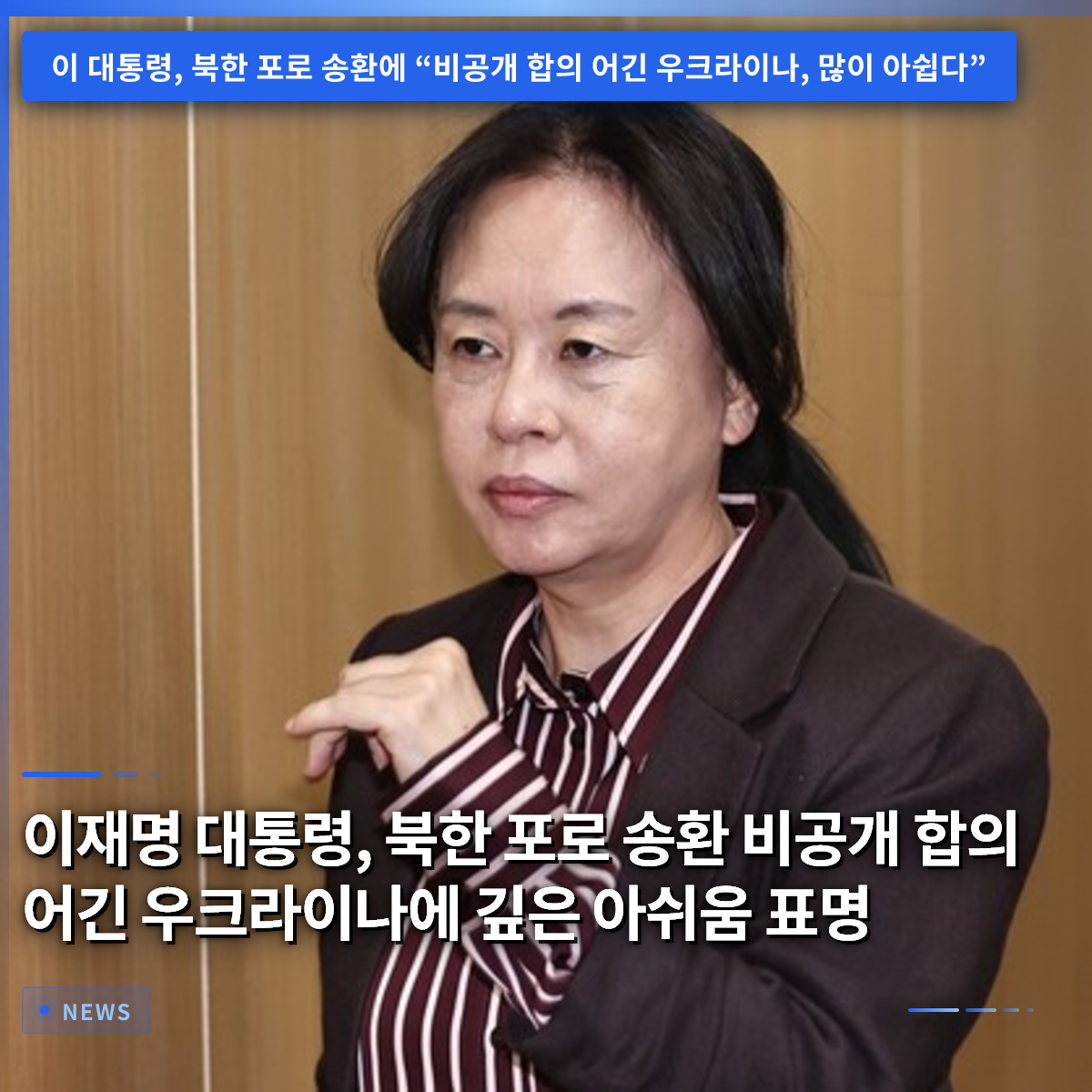
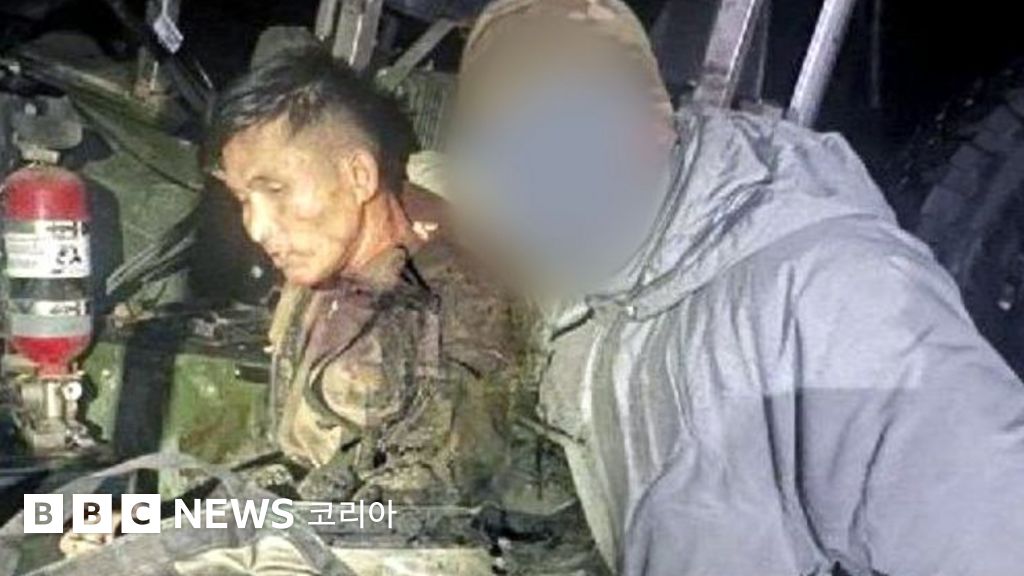
President Lee Jae-myung stated that Ukraine’s official announcement on the 24th regarding the return of two North Korean prisoners of war to South Korea was a deeply regrettable decision that broke a confidential agreement. Currently on a state visit to Mexico, the President strongly criticized the move via his social media, calling it irresponsible to reveal such matters to the world while disregarding national security and the safety of the individuals involved. This diplomatic conflict came to the surface after Ukrainian President Volodymyr Zelenskyy directly mentioned the return in his speech at the UN General Assembly the previous day. Matters involving North Korean prisoners of war carry immense implications for the situation on the Korean Peninsula and inter-Korean relations, making strict security essential. Within the South Korean government, there were sufficient opinions suggesting that publicizing this would help restore public approval ratings. However, since both countries had agreed to handle the matter confidentially, prioritizing national interests and the safety of the people, this sudden action is a painful blow. This case deeply underscores how crucial the management of sensitive information and the building of trust between nations are on the diplomatic stage.
=
President Lee Jae-myung Expresses Deep Regret Over Ukraine’s Breach of Confidential Agreement on North Korean POW Return
1. Ukraine’s Sudden Disclosure and Background
Behind the Ukrainian government’s announcement to the world about the return of North Korean prisoners of war, there may be their own urgent political calculations or an intention to draw international attention. It is highly likely that they used this as a means to boost the morale of their war-weary citizens and to secure more military support from Western allies. However, such a unilateral announcement can only be seen as a rude action that completely disregards the position of the South Korean government, the party involved. In the diplomatic arena, ignoring a counterpart’s request for confidentiality can backfire, pouring cold water on future bilateral cooperation. Just as there are promises that must be kept even between friends, inter-state diplomacy must be firmly woven together by the invisible thread of trust to be sustained. President Zelenskyy’s remarks may have achieved short-term promotional effects, but they have left a significant blemish on long-term diplomatic assets. While one can intellectually understand Ukraine’s desperate wartime situation, the manner in which they handled national security was far too reckless.
Ukraine’s unilateral disclosure of the POW return was an irresponsible diplomatic action aimed at short-term promotion.
2. The Legitimacy and Reasons for the Confidential Agreement
The return of North Korean prisoners of war to their home country is a sensitive diplomatic issue akin to a time bomb, capable of shaking inter-Korean relations and the geopolitical landscape of Northeast Asia, rather than simply moving people. If this process were exposed without prior filtering, there is a very high risk that it could provoke a reaction from the North Korean regime, causing a security crisis on the Korean Peninsula to escalate instantaneously. The government’s decision to keep this strictly hidden and handle it quietly was a high-level strategic judgment made solely to protect national safety and the peace of its citizens. In a diplomatic situation akin to walking on thin ice, where a single small sound can shake the entire nation, keeping one’s mouth shut was the best course of action. In the political sphere and among some surrounding parties, there is always the temptation to immediately inform the public of such major events to showcase achievements. Indeed, there were many internal suggestions that publicizing this fact would greatly help boost the government’s approval ratings. Nevertheless, the leader’s choice to set aside immediate political gains and choose silence was because national interests take far precedence over partisan interests. The sense of frustration a leader feels when matters that should be quietly concluded under strict security are tangled up by external sudden variables is beyond imagination.
Keeping the return of North Korean POWs confidential was an unavoidable choice to protect national security and peace on the Korean Peninsula.
3. The Leader’s Choice to Resist the Temptation of Approval Ratings
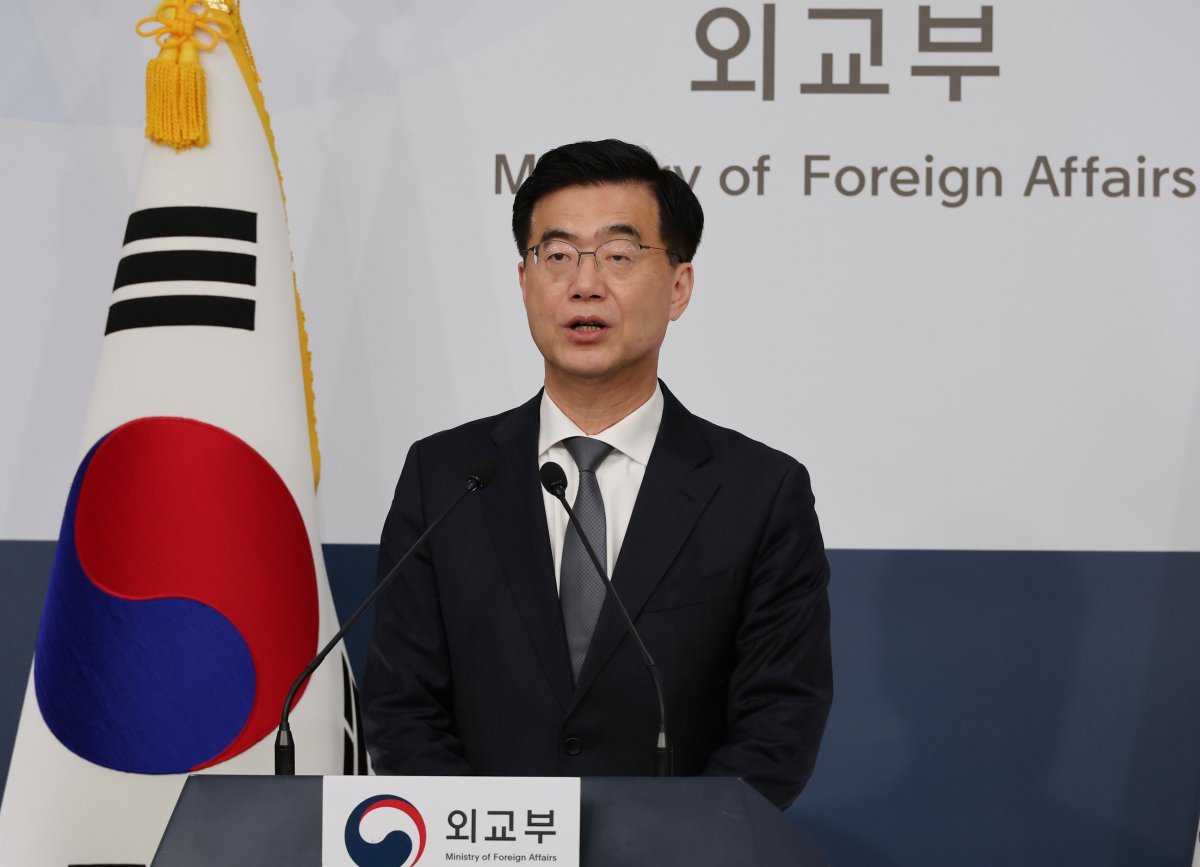
In politics, there are countless moments when one desires to boast about sweet, immediate results or faces opportunities to garner explosive public support. This major diplomatic achievement of returning North Korean POWs was an issue that could have led to immense acclaim and a surge in approval ratings if the government had promoted it extensively. In a situation where there seemed to be no reason to hide the news, the government held back solely to protect the nation’s safety and prevent unnecessary friction with North Korea. It was a possible decision because they well understood that quietly securing practical benefits behind the scenes, rather than seeking visible applause, is the true path to serving the country. The patience to silently suppress the voices of numerous aides who likely urged them to break the news right then and there is a rare virtue of leadership. They resisted the temptation of that moment, when, if they had only considered political pros and cons, they might have wanted to appear on television to wear medals and brag. This decision, which chose the stability of the nation with a far-sighted perspective rather than chasing the mirage of immediate approval ratings, will likely receive a correct evaluation in history later on.
Maintaining silence, despite the potential for a significant boost in approval ratings, was the result of deep anguish dedicated solely to the nation.
4. An Irresponsible Act Disregarding National Interests and Lives
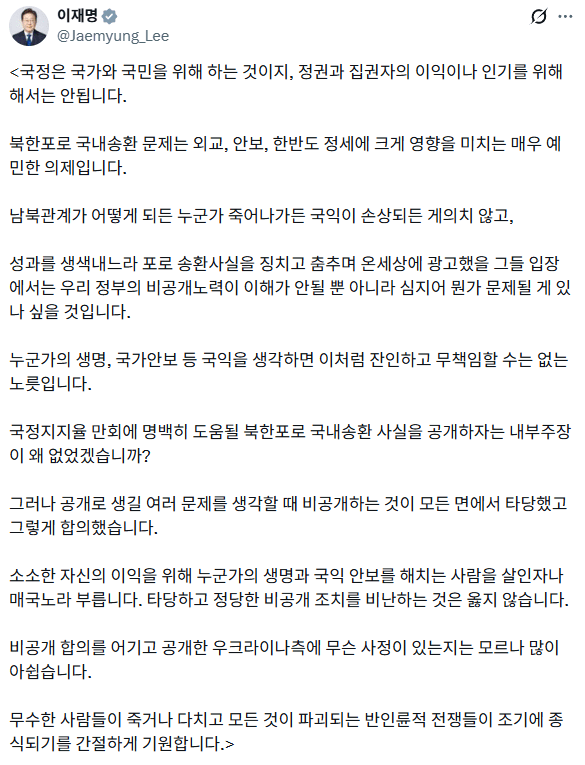
On the diplomatic stage, betraying a counterpart’s trust and unilaterally breaking promises inevitably leads to self-inflicted diplomatic isolation. As in this incident, leaking secrets to tend to one’s own political neighbors without considering another country’s security sensitivities is a very cruel attitude. They appeared to be solely eager to publicize their achievements, with no regard for the safety of the former prisoners or the potential diplomatic repercussions. The reason President Lee Jae-myung used such strong language to express his regret in a post on X is precisely this painful rebuke of their irresponsibility. Using someone’s life and national security as hostages for small political gains is an inhuman act that can never be tolerated. A country that loses its credit in the international community will eventually become a lonely island, receiving no help when a greater crisis strikes. For Ukraine to truly become a responsible member of the international community through this incident, it must deeply realize how precious trust with other nations is.
Unauthorized exposure of a counterpart’s confidentiality request is an irresponsible action that threatens national security and lives.
5. Implications and Challenges for the Situation on the Korean Peninsula

Due to this incident, the situation on the Korean Peninsula, which is already like walking on thin ice, faces the risk of entering a state of unpredictable tension once again. Given that North Korean authorities have been extremely sensitive to matters related to defection or the return of prisoners of war, it is highly likely they will not let this public announcement pass without a reaction. The government has been burdened with unexpected diplomatic responsibilities due to Ukraine’s sudden action, and emergency measures are now required for managing relations with North Korea. This incident may even raise doubts about whether counterparts will trust our promises in numerous future behind-the-scenes contacts or confidential negotiations between the two Koreas. The government’s diplomatic and security departments must meticulously analyze the implications of this situation and make all-out efforts to prevent additional security threats. Alleviating public anxiety and establishing a steadfast security posture is the critical mission the administration must fulfill first at this moment. This incident reaffirms that diplomacy is not a feast of a hundred words, but a continuous series of intricate strategic maneuvers and trust built in unseen places.
Ukraine’s sudden announcement has left behind the heavy tasks of managing the situation on the Korean Peninsula and restoring diplomatic trust.
6. Outlook and Future Response Directions
Going forward, our government must use this incident as a lesson to establish more thorough and robust safety measures in confidential negotiations with the international community. Even with the closest allies, specific agreements must be documented to control unilateral actions regarding matters directly related to national security. Additionally, it is paramount that the domestic political sphere avoids unnecessary partisan fights and maintains a bipartisan security cooperation system. Citizens must also understand the complex context hidden behind diplomacy and steadfastly support the government’s security policies with unwavering hearts. While praying that all those suffering from war return to the embrace of peace, we must firmly protect our security with our own hands. At this point, a wise diplomatic strategy that prioritizes only national interests and the safety of the people is urgently needed amid the turbulent waves of the international situation. We hope that on the numerous diplomatic tests to come, our government will overcome this pain and demonstrate a more mature security capability.
We must wisely overcome upcoming diplomatic challenges based on thorough security preparations and bipartisan cooperation.
Frequently Asked Questions
=