Pension savings funds are the most powerful tax-saving financial product, allowing you to reliably claim tax refunds during the annual year-end tax settlement while simultaneously building your retirement assets. Recently, as more capital flows into direct investments in stocks and index-tracking exchange-traded funds (ETFs), this account has become an essential holding for many office workers. The era of simply leaving money in bank deposits is fading; instead, the trend is shifting toward a method where individuals select their own investment vehicles to focus assets on growth. While retirement planning once felt like a distant concern, it is now imperative to establish a rigorous tax-saving and asset-growth strategy from the moment you start your career. In this article, we will carefully examine the specific benefits of pension savings funds, how to maximize tax deduction limits, and the know-how for constructing a successful investment portfolio.
=
Comprehensive Guide to Pension Savings Fund Tax Deduction Limits and Retirement Portfolio Strategies
1. What is a Pension Savings Fund?
A pension savings fund is an individual contribution pension account opened through a securities firm, allowing you to invest freely in stocks, bonds, and exchange-traded funds (ETFs). Its most significant feature is the strong tax-saving benefits provided by the government to encourage retirement security. It is widely regarded as an essential account that office workers must manage to receive tax refunds every year during the year-end tax settlement season.
If you look around, you will frequently see colleagues who used to sigh over heavy tax bills now receiving refunds of several hundred thousand won through this account. Unlike pension savings trusts or insurance products sold by banks, this account allows subscribers to directly select and swap high-quality products according to market conditions. Consequently, it offers far more favorable conditions for defending against inflation and actively growing assets.
A pension savings fund is an account opened through a securities firm that allows you to grow assets through direct investment while also enjoying tax benefits.
2. Tax Deduction Limits and Tax-Saving Effects
Contributions to a pension savings fund are eligible for tax deductions during the year-end tax settlement, earning it the nickname “cheat code” that creates a 13th-month salary for office workers. With a standalone pension savings account, you can claim deductions on contributions of up to 6 million won annually. When combined with an Individual Retirement Pension (IRP) account, the limit increases to a maximum of 9 million won. Office workers with a total annual income of 55 million won or less are subject to a 16.5% deduction rate, allowing them to receive a maximum tax refund of 1.485 million won.
Even office workers with a total annual income exceeding 55 million won can enjoy a 13.2% deduction rate, resulting in a substantial refund. If you consistently make automatic monthly transfers of a fixed amount, you will directly see the refund amount printed on your year-end tax settlement documents. Reinvesting this refunded money or using it for living expenses provides a practical boost to your household economy.
Pension savings funds offer tax deductions of up to 16.5% on annual contributions of up to 6 million won.
3. Investment Advantages: No Limits on Risky Asset Allocation
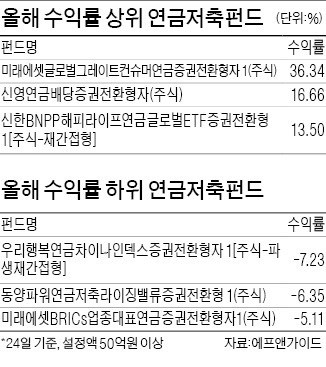
Unlike standard retirement pension accounts, pension savings funds have a significant advantage: there are no restrictions on the allocation ratio of equity assets or exchange-traded funds (ETFs). While retirement pension accounts require at least 30% to be allocated to safe assets, pension savings funds allow you to allocate 100% of your portfolio to equity assets. Therefore, younger office workers or investors with a long time until retirement can focus entirely on aggressive growth.
In practice, many investors are achieving high returns by investing the majority of their assets in ETFs tracking major U.S. indices or products related to the Nasdaq index. It is popular among office workers to consistently buy products tracking the S&P 500 or Nasdaq 100 indices for several weeks each month on payday, a method known as systematic investment. This approach focuses on accumulating shares based on the belief that the stock market trends upward over the long term, even if it experiences short-term declines.
Pension savings funds have no limits on equity asset allocation, allowing for aggressive management with 100% equity products.
4. Retirement Portfolio Construction Strategy
To successfully build retirement funds, a clear portfolio diversification strategy that remains unshaken by volatility is essential. A significant portion of your assets should be invested in index-tracking products containing U.S. large-cap tech stocks or global blue-chip companies to maximize capital gains. A wise approach is to mix in dividend stocks or bond products for the remaining portion of assets to enhance defensive capabilities during market downturns.
Rather than stressing yourself out by checking stock charts every day, it is better for your mental health to set up a system where purchases are made automatically on predetermined dates. To increase your chances of success, you must manage your account consistently with the mindset that a falling market allows you to buy more shares at a lower price. The key is to stay committed to high-quality indices that will survive in the long term, rather than frequently switching stocks based on rumors.
The core of the portfolio is to continue systematic monthly purchases centered on U.S. major index-tracking products.
5. Tax Benefits Upon Pension Receipt
Even after the accumulation period ends and you reach the age of receiving the pension, pension savings funds continue to offer significant tax-saving advantages. If you receive the funds in the form of a pension after age 55, you only need to pay a very low pension income tax of 3.3% to 5.5%, depending on your age, instead of standard income tax. If your annual receipt amount exceeds 15 million won, you can choose between comprehensive income tax and separate taxation, significantly reducing your tax burden.
The fact that you do not have to worry about a tax bomb while creating a steady monthly cash flow after retirement provides great peace of mind for retirees. The money consistently contributed from your younger years acts as a reliable cash pipeline, similar to monthly rent, ensuring a comfortable retirement. Considering not just the immediate year-end tax settlement benefits but also the distant future receipt stage, pension savings funds are not an option but an essential financial product.
Receiving the funds as a pension after age 55 allows you to enjoy the benefit of a low tax rate of 3.3% to 5.5%.
6. Precautions and Future Outlook
Since pension savings funds are products that require locking in money for decades for long-term investment, early termination may result in disadvantages such as having to return tax benefits. Therefore, you should absolutely not deposit funds that you need to use within the next few years; they should be used only as surplus funds for retirement preparation and tax deduction purposes. As the aging society progresses rapidly, the inflow of office workers looking to save on taxes and prepare for retirement is expected to accelerate further.
We recommend opening a pension savings account through a nearby securities firm app right now and starting automatic transfers with an amount you can comfortably afford each month. The day will definitely come when you discover that your account has grown into a massive asset through consistent accumulation, even with small amounts, and you will smile. Start smart tax-saving investments today to prepare for a prosperous and leisurely retirement life on your own.
Since there are disadvantages to early termination, you should start with surplus funds that can be maintained long-term, and its importance will grow in the future.
Frequently Asked Questions
=