Many employees regret hitting their knees in despair after blindly withdrawing their retirement pension as a lump sum without fully understanding the methods, only to pay a hefty tax bill of several million won all at once. Since retirement benefits are a valuable lump sum earned through years of hard work, it is essential to have the wisdom to maximize tax savings while safely utilizing these funds for retirement living expenses. Before visiting a bank or securities firm, accurately comparing the tax differences between lump-sum and pension receipts will make you realize why choosing the pension method is the smarter option. The reason many people are recently transferring their funds to securities firm accounts to enjoy compound interest is precisely due to these tax-saving benefits and the freedom in asset management. In this article, we will carefully go through specific methods to receive your retirement pension wisely and keep your retirement funds secure. We will also explain the application procedures and document preparation processes, which may seem complex, in an easy-to-understand manner, so please follow along step by step to the end.
=
How to Receive Your Retirement Pension: A Practical Strategy to Save Taxes by Choosing a Pension Over a Lump Sum
1. Understanding the Basic Structure of Retirement Pension Receipts
When you retire or change jobs, the retirement benefits you receive are accumulated in various forms, such as Defined Benefit (DB) or Defined Contribution (DC) plans. In a DB plan, the company manages the funds and guarantees a specific amount at the time of retirement. In a DC plan, the contributions made by the company each year are invested directly by the employee in financial products to grow. These valuable accumulated retirement funds can only go through the receipt process after they are legally transferred to an Individual Retirement Pension (IRP) account. In the past, companies might have deposited retirement benefits directly into personal bank accounts, but now, to prevent the depletion of retirement funds, transfer to an IRP account is mandatory. Once the funds are in this account, you can either terminate the account immediately to withdraw them as a lump sum or receive them in installments as a pension after the age of 55. Therefore, understanding the nature of your enrolled plan and deciding which financial institution to open your IRP account with is the first step in the entire receipt process. Retirement benefits transferred to an IRP account are not taxed immediately; instead, taxation is deferred, allowing you to enjoy the compound interest effect as your funds grow intact. Even if you change jobs, you can continue to accumulate funds in this account, serving as a sturdy fence to protect your assets securely until retirement.
Retirement benefits must first be transferred to an Individual Retirement Pension (IRP) account, which allows you to defer taxes and maximize the compound interest effect.
2. Tax Differences Between Lump-Sum and Pension Receipts
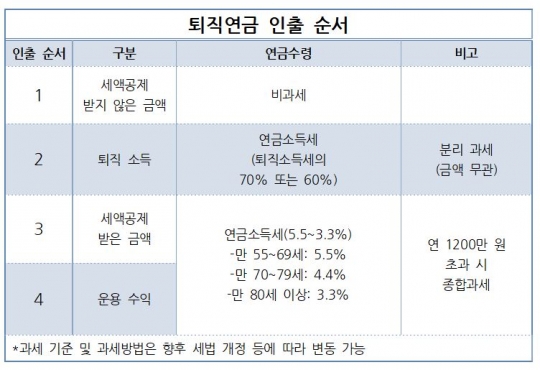
When choosing how to receive your retirement pension, the most critical factor to consider is undoubtedly taxes, and there is a vast difference in tax burden between lump-sum and pension receipts. If you withdraw your retirement benefits as a lump sum because you urgently need a large amount of cash, the full retirement income tax is applied based on your years of service, resulting in a significantly smaller take-home amount than you might expect. On the other hand, if you leave these funds in your IRP account and receive them as a pension in installments after the age of 55, you can receive a tax reduction of 30% to a maximum of 40% on the original retirement income tax. For example, if an employee is required to pay 10 million won in taxes, choosing the pension receipt method can legally save them hundreds of thousands of won in taxes. Furthermore, it is advantageous because a lower tax rate, known as pension income tax, is applied to the earnings generated from managing financial products within the account during the pension receipt period. By establishing a structure where you receive a steady monthly pension, similar to rent, you reduce the risk of depleting your assets all at once and avoid a tax bomb, achieving a two-fold benefit. Many people around you might withdraw everything as a lump sum because they claim they need a large sum of cash, but they often realize later that calculating the money lost to taxes results in a significant loss. If you look at your life after retirement in the long term, carefully considering tax benefits and receiving the funds as a pension is far more beneficial.
Receiving a lump sum incurs the full retirement income tax, whereas receiving a pension allows for a tax reduction of up to 40%, making it much more advantageous.
3. Procedures for Opening and Transferring an Individual Retirement Pension Account
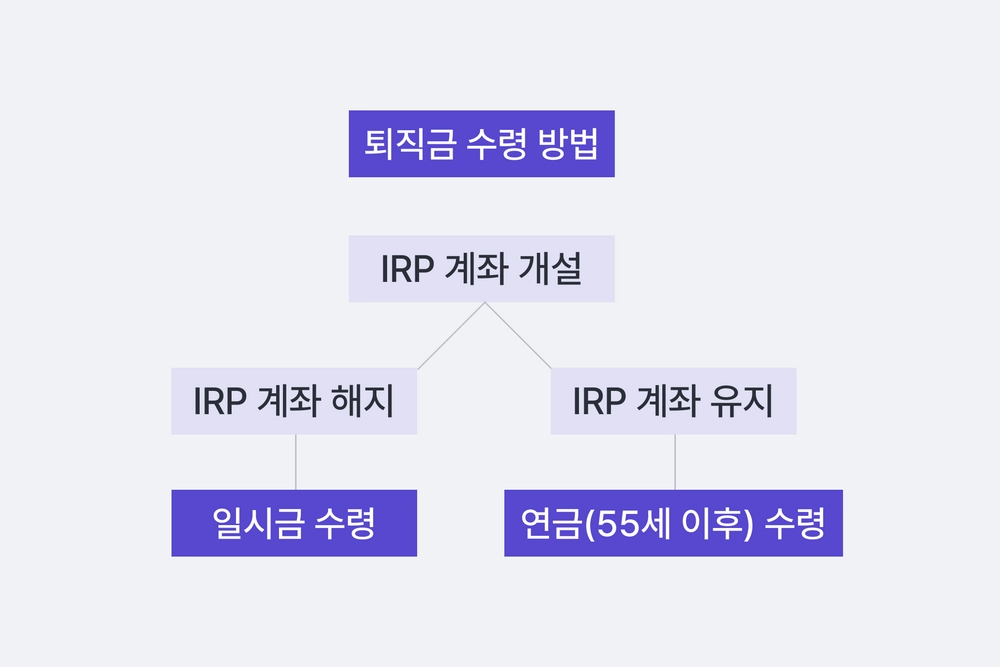
If you have decided to receive your retirement benefits as a pension, the first step is to open an Individual Retirement Pension (IRP) account at a securities firm or bank that is convenient for you to deal with. Recently, there has been a very active trend of transferring funds to securities firms due to their lower fees and the ability to invest in a wider variety of products. Once you have opened the account, you can officially request the HR department of your previous company to deposit your retirement benefits into this account. The company will deposit the full amount of retirement benefits into the employee’s IRP account within a specified period from the date of retirement, and documents such as the retirement income withholding receipt will be processed at this time. After confirming that the funds have arrived in the account, you can proceed with the pension commencement application through the financial institution’s website or mobile app, ensuring a smooth process. While it may seem complex to those doing it for the first time, anyone can easily start receiving their pension from home by following the on-screen instructions on their smartphone step by step. Opening the account non-face-to-face via a mobile app without visiting a branch allows you to enjoy various fee discount benefits, making it a two-for-one deal. It is wise to carefully compare the terms of various financial institutions, not just the bank you usually deal with, and choose the most advantageous one.
Open an Individual Retirement Pension account at a securities firm or bank, request the transfer from your company, and then apply for pension commencement via a mobile app.
4. Strategies for Setting Pension Receipt Period and Amount
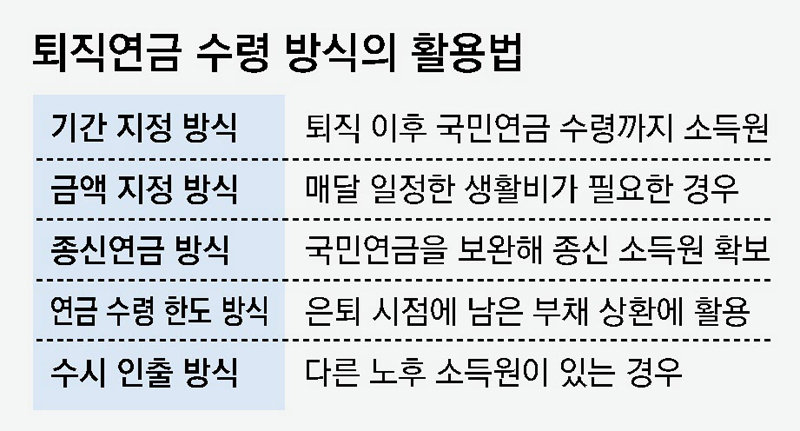
When you start receiving a pension through your IRP account, you can freely set the receipt period according to your financial situation, determining how much to receive each month and for how long. It is not always best to receive it for the longest possible duration; you should design it by comprehensively considering the period immediately after retirement when living expenses are highest and the time when the National Pension begins to be paid out. Since activity levels and expenses may be relatively high between ages 60 and 70 after retirement, it is wise to set a slightly more generous receipt amount during this period and adjust the amount after the age when the National Pension is fully paid out. Additionally, there is a system called the pension receipt limit, which allows withdrawals only up to a specified amount each year, safely preventing the depletion of assets all at once by the state. If you withdraw funds exceeding this limit, it is considered a general withdrawal rather than a pension receipt, and you may lose tax benefits, so you must pay close attention. It is advisable to harmonize the monthly pension amount with other means, such as personal pensions or housing pensions, to fully cover your retirement living expenses. As retirement planning experts often emphasize, you should not just look at the total amount of money you have but plan by working backward based on the cash flow hitting your account each month. By preparing meticulously in this way, you can perfectly prevent the panic of suddenly running out of money in your old age.
It is important to customize the pension receipt period and monthly payment amount based on your retirement timing and expected expenses.
5. Early Termination and Exceptional Withdrawal Reasons
While learning about how to receive your retirement pension, you may encounter situations where you need a large sum of money before retirement and must terminate the account or withdraw funds. In principle, IRP accounts cannot be voluntarily terminated or withdrawn from before the age of 55, but partial withdrawals are permitted if they fall under exceptional reasons stipulated by law. These include cases where a non-homeowner subscriber needs to purchase a home in their own name or secure a deposit for a lease, and cases where the subscriber or a family member requires care for more than six months due to illness or injury. Additionally, if you face extreme economic difficulties, such as receiving a bankruptcy declaration or undergoing personal rehabilitation proceedings, you can withdraw funds by submitting the required supporting documents. However, if you terminate the account midway due to a simple change of heart or personal reasons that do not meet these legal criteria, you will have to return all the tax deduction benefits you received and face a heavy other income tax bill. Therefore, unless you are in a dire situation where you absolutely need a lump sum immediately, the right answer is to keep the account intact and enjoy the compound interest benefits to the end. Many people carelessly withdraw these valuable retirement funds to buy a house, and one of the biggest reasons they regret it upon reaching retirement is this early withdrawal. If it is not an unavoidable emergency, it is much more beneficial in the long run to keep the pension account firmly closed and protected.
Unless you meet legal exceptional reasons such as home purchase for non-homeowners or long-term care, early termination results in significant tax disadvantages, so proceed with caution.
6. Outlook for Utilizing Retirement Pensions for a Successful Old Age
In the upcoming aging society, it will be difficult to maintain a comfortable life relying solely on the National Pension provided by the state, so the role of individually managed retirement pensions is becoming absolutely crucial. As the system continues to improve, an environment is being created where subscribers can more conveniently grow their assets and save on taxes, so you must adapt quickly to these trends. The key to preparing for old age is to consistently strengthen your professional skills and increase your income during your working years, thereby naturally growing your retirement pension accumulation. When the time of retirement approaches, rather than simply receiving a lump sum and spending it, you should actively utilize the pension receipt methods learned today to complete a structure where you receive a steady monthly income for life. A small action, such as opening your smartphone right now to check how much retirement pension you have accumulated and where, and comparing various management products from securities firms and banks, will determine your secure old age. We hope you will start preparing step by step from now to turn your approaching retirement from a source of fear into the starting point of a wonderful second life. It is essential to keep a close eye on changes in the financial market and periodically check and update where your assets are invested. Preparing for retirement is not something that happens overnight; it is a beautiful result completed by the accumulation of wise choices over a long period.
You should organically combine the National Pension and retirement pension and thoroughly prepare the pension receipt method to welcome a secure and stable old age.
Frequently Asked Questions
=