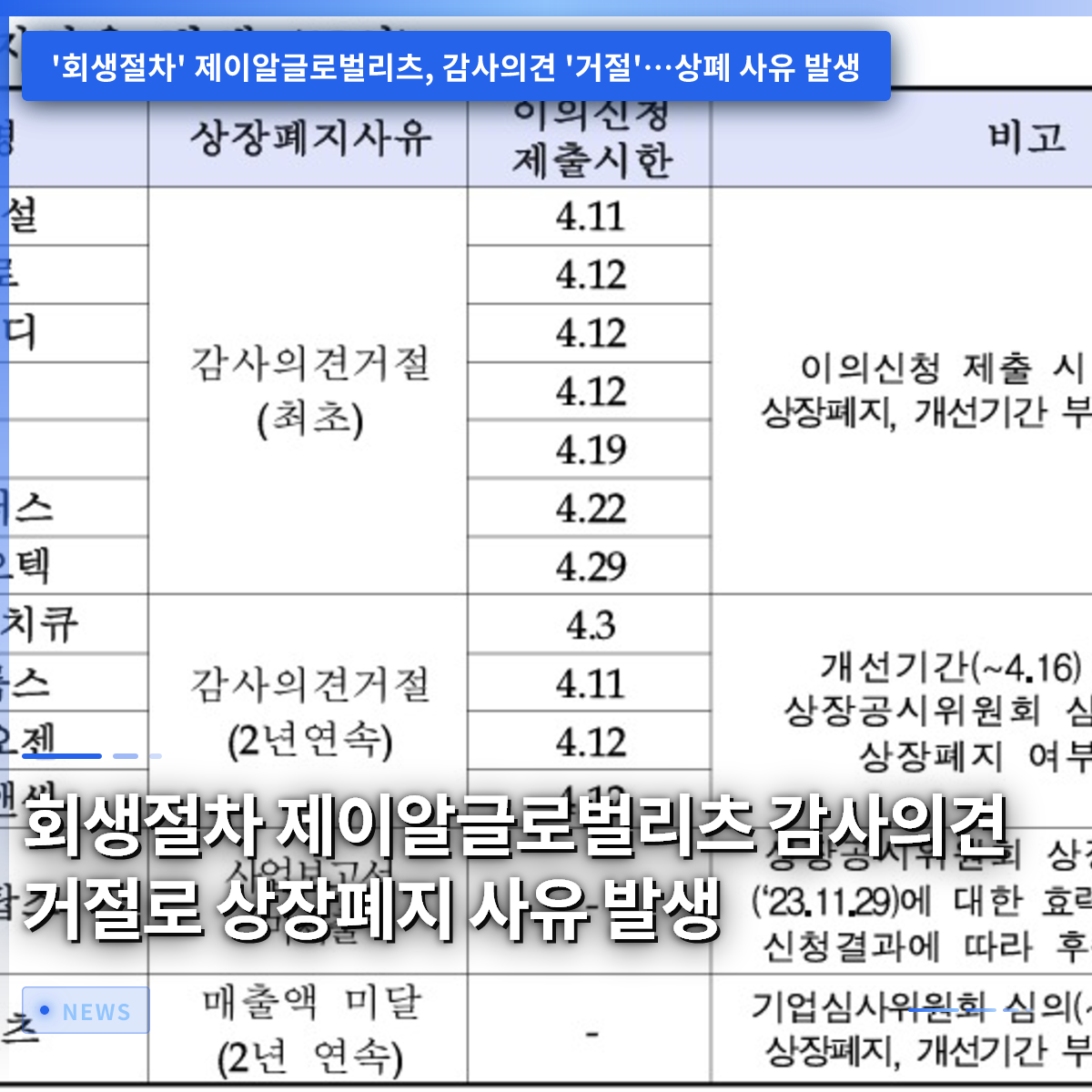
JR Global REIT, which is currently undergoing rehabilitation proceedings, has been notified of a disclaimer of opinion by its external auditor, triggering grounds for delisting in the stock market. The company, whose trading has been suspended since April, faces a significant crisis as significant uncertainties regarding the going concern assumption have been highlighted. In particular, the company recorded a massive loss in its first-half results after writing off the entire amount of goodwill remaining on its books. Investors are expressing shock at the sudden deterioration of financial statements and the prolonged trading suspension. In this article, we will examine the current situation of JR Global REIT and the causes of the delisting crisis in detail. We will also carefully review the procedures the company intends to follow to resolve the issue.
=
JR Global REIT Faces Delisting Grounds Due to Disclaimer of Opinion Amid Rehabilitation Proceedings
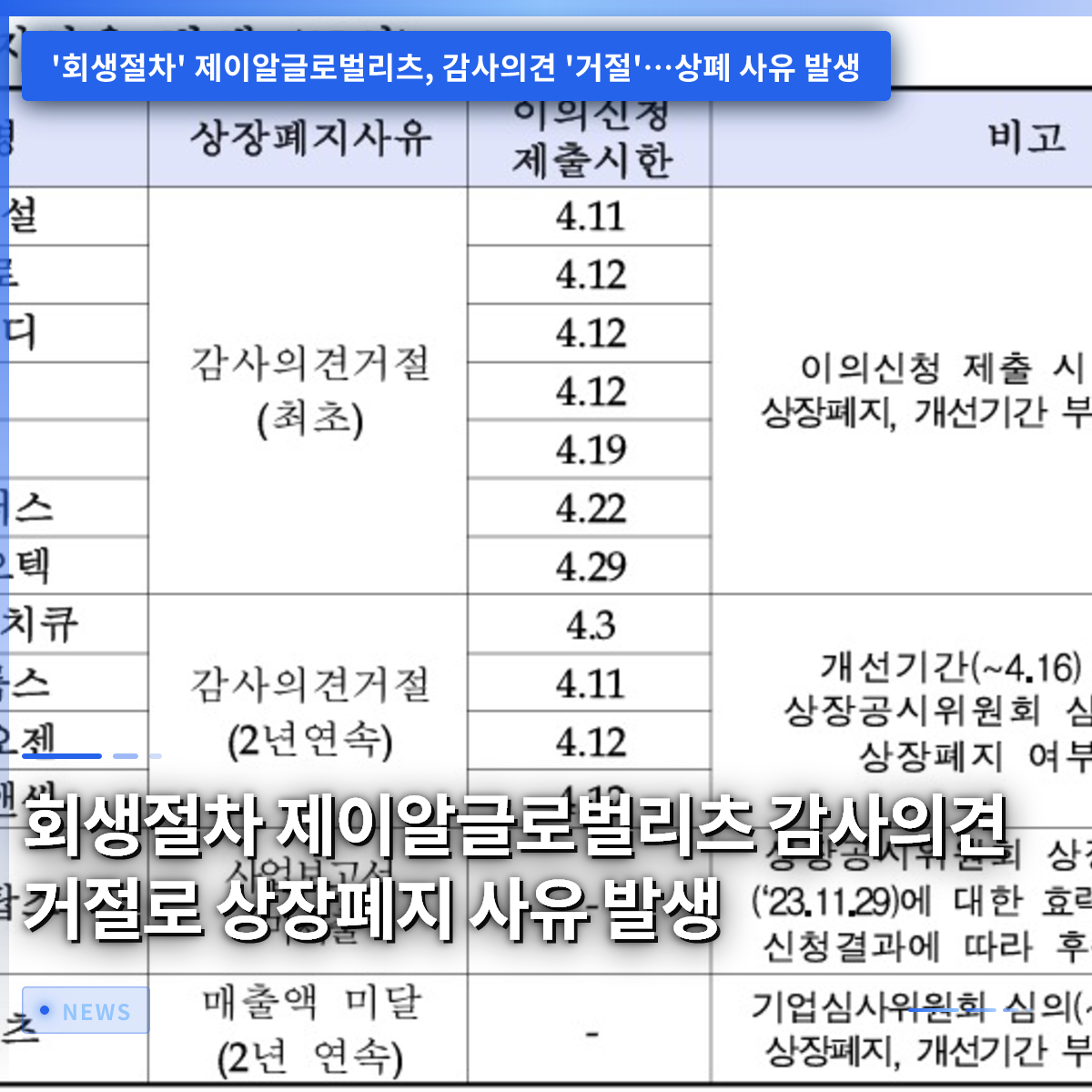
1. Disclaimer of Opinion by External Auditor and Delisting Crisis
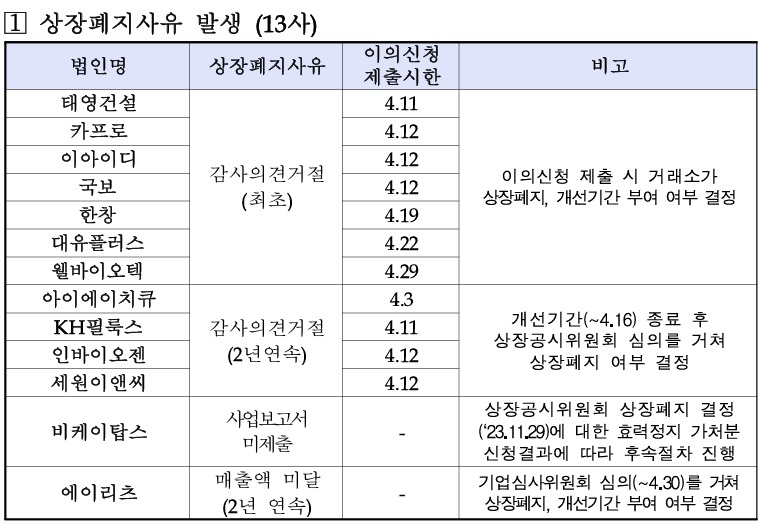
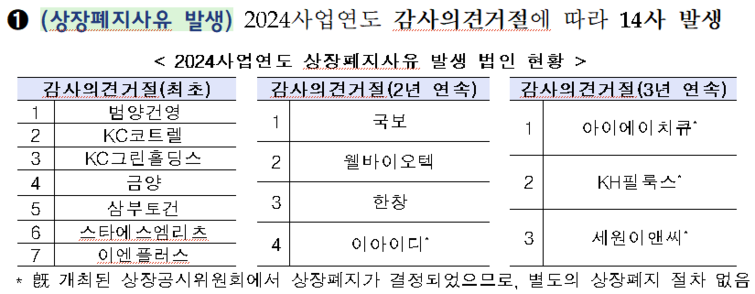
Recently, JR Global REIT received a stark notification from its external auditor, Hanul Accounting Firm, stating that a disclaimer of opinion was issued for both the consolidated and separate financial statements for the first half of this year. The shock in the market was even greater given that the company had received an unqualified opinion in the previous fiscal year. The auditor cited significant uncertainty regarding the going concern assumption, indicating that the company may find it difficult to continue its business operations, as the reason for the disclaimer. According to the Financial Supervisory Service’s electronic disclosure system, this disclaimer of opinion constitutes grounds for delisting under the listing regulations of the Korea Exchange. Consequently, the Korea Exchange immediately guided the relevant procedures and set the deadline for the company’s objection as the 19th of next month.
For shareholders who have been left in limbo since stock trading was halted after the company applied to the Seoul Bankruptcy Court for the commencement of rehabilitation proceedings at the end of April this year, this is another devastating blow. With the occurrence of delisting grounds, the trading suspension is expected to continue for the time being. Investors are anxiously monitoring related news, worried about the status of their assets. The company has repeatedly emphasized that delisting has not yet been finally confirmed. It is showing its will to break through the crisis by actively filing an objection and preparing an improvement plan within the remaining deadline.
JR Global REIT received a disclaimer of opinion, triggering grounds for delisting.
2. Full Impairment of Goodwill and Deterioration of First-Half Results

The day before the disclaimer of opinion was issued, JR Global REIT announced a significant revision to its net income for the first half of this year, reflecting the external audit results. Initially expected to record a profit of 24.9 billion won, the figure was corrected to a loss of 107 billion won. The decisive reason for this sharp decline in performance was the full impairment of 125.6 billion won in goodwill, which had been recorded as an intangible asset on the books. The value of this intangible asset, arising from past business combinations, has been completely written off from the books to reflect the current market conditions and the company’s rehabilitation status.
As the goodwill from the asset section disappeared, an equivalent amount was recognized as an expense under impairment loss, causing the scale of the net loss to snowball. It is as if the book value of assets evaporated overnight, much like suddenly losing one’s wallet while walking down the street. Shareholders’ anxiety has reached its peak upon hearing the news of the massive accounting loss. However, experts analyze that this was an unavoidable measure in accordance with accounting standards that strictly evaluate a company’s financial condition. As a result, the company has taken on the heavy task of re-establishing the soundness of its financial structure.
The full impairment of 125.6 billion won in goodwill led to a correction of first-half results to a massive loss.
3. Explanation of Non-Cash Accounting Treatment Without Cash Outflow

To reassure investors shocked by the news of the massive loss, JR Global REIT immediately moved to clarify the situation. The company explained that the goodwill impairment reflected this time is not an expense that involves actual cash leaving the company’s coffers. It emphasized that this constitutes a non-cash accounting treatment that merely adjusts the book value on the accounting books. The company’s stance is that this is merely a process of removing accounting bubbles that had been recorded in the past and does not directly impact actual cash flow.
This explanation aims to clarify that there is no direct impact on the funding sources for executing the voluntary restructuring support procedure currently in progress and the debt repayment plan. Shareholders and creditors are most concerned about the company’s actual funding lines drying up, and the company has drawn a clear line on this issue. The logic is that although the red ink on the books has grown, there is no hindrance to the actual fund management required to revive the company. However, with the accounting deficit snowballing, it does not appear easy to immediately dispel the market’s cold gaze. It remains to be seen how much the company’s explanation can calm the nerves of anxious investors.
The goodwill impairment is a non-cash accounting treatment with no actual cash outflow, so it has no direct impact on fund management.
4. Delisting Procedures and the Company’s Objection Plan
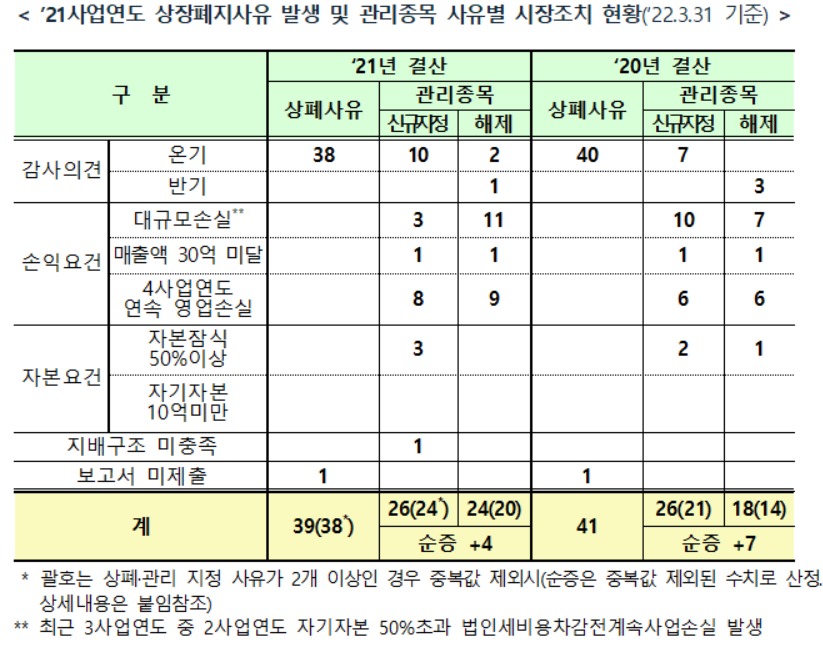
The occurrence of delisting grounds due to a disclaimer of opinion does not mean the stock will be immediately and completely removed from the market. According to the Korea Exchange’s regulations, the company has the opportunity to file an objection and submit an improvement plan within a specified deadline. JR Global REIT has formulated a concrete plan to directly break through the delisting crisis by utilizing this point. It plans to prepare a thorough improvement plan and submit it to the exchange during the objection period, which runs until the 19th of next month.
The company’s strategy is to safely complete the upcoming re-audit or the audit for the next fiscal year, obtain an audit opinion again, and completely resolve the current delisting grounds. The company is in a difficult situation where it must overcome the major hurdle of rehabilitation proceedings while also securing the maintenance of its listing. The company’s management must engage in intense negotiations among the court, the creditor group, and regulatory bodies. For shareholders, it is time to critically assess the effectiveness of the improvement plan the company will submit.
The company plans to resolve the delisting grounds by filing an objection and submitting an improvement plan within the deadline.
5. The Current State of Overseas Real Estate Public REITs
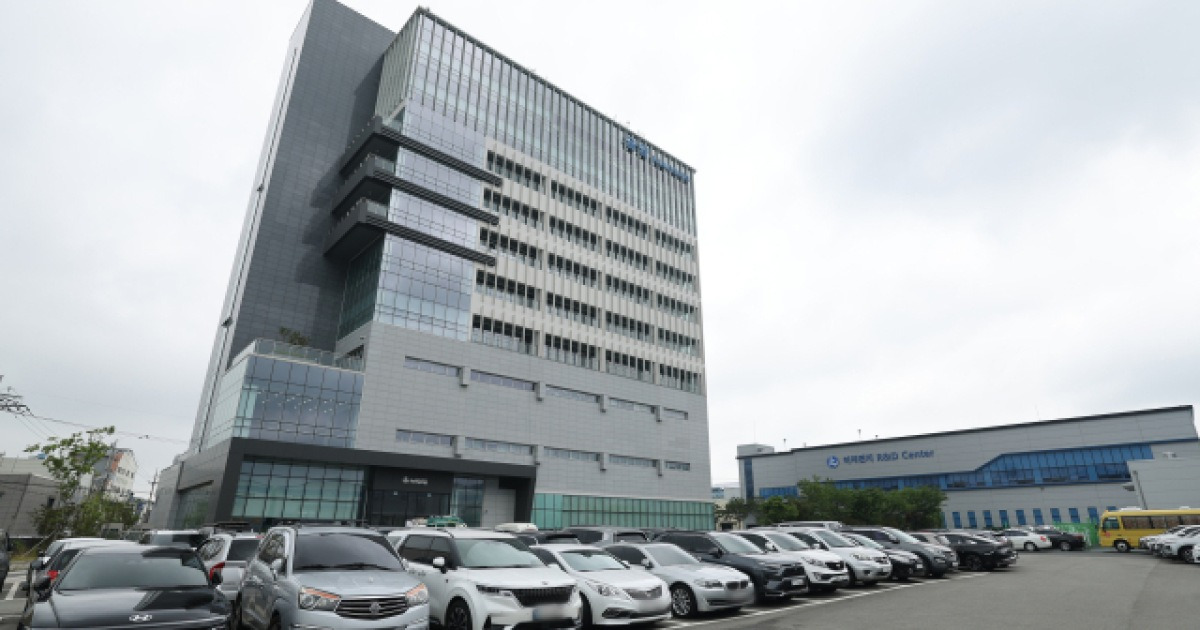
JR Global REIT is a representative overseas real estate public REIT that has invested in assets such as the Finance Tower, a large office building in Brussels, Belgium, and properties in Manhattan, New York, USA. It was a stock that listed on the Korea Exchange in 2020 amidst intense interest from general investors, promising stable dividends. It was a symbolic presence of a REIT expected to provide substantial returns monthly or quarterly based on high-quality overseas assets. However, it ultimately collapsed, failing to overcome the global trend of rising interest rates and the slump in the overseas commercial real estate market.
As the value of the overseas real estate market declined and interest burdens on borrowings snowballed, the company eventually knocked on the door of the Seoul Bankruptcy Court in April this year. Individual investors, who had entrusted their money expecting stable dividend income, have suffered significant damage as trading has halted and the company faces a delisting crisis. This is a painful case illustrating how the prestige of a glamorous overseas public REIT can plummet to rock bottom in an instant. It serves as a heavy warning to the asset market about how changes in the external environment of the real estate market can lead to terrifying outcomes.
JR Global REIT, which invested in overseas real estate in Belgium and the US, faces a crisis due to market slump.
6. Future Outlook and Negotiation Process with Creditors
JR Global REIT plans to formally present its carefully prepared debt repayment plan to creditors in the near future. It intends to steadily proceed with the legally required essential decision-making procedures, such as the meeting of debenture holders. By successfully completing these processes, the company aims to successfully graduate from the voluntary restructuring support system and fully normalize its financial structure. Reaching a smooth agreement with the creditor group will be the most critical key to the early termination of rehabilitation proceedings and the maintenance of the listing.
From the perspective of investors, they must keep a close watch on whether the company’s self-rescue efforts will bear practical fruit. The fate of this stock will be completely determined by the judgment of the rehabilitation court and the review results of the exchange. Rather than making reckless investments, wisdom is needed to carefully check the speed and transparency of the restructuring process currently underway by the company. They must stay alert to the content of upcoming disclosures and the results of the creditors’ meeting to formulate a response strategy. Attention is focused on the company’s moves during the remaining schedule to see if a company that has lost market trust can rise again.
The creditors’ meeting and the execution of the repayment plan will determine the success or failure of future rehabilitation graduation and normalization.
Frequently Asked Questions
=