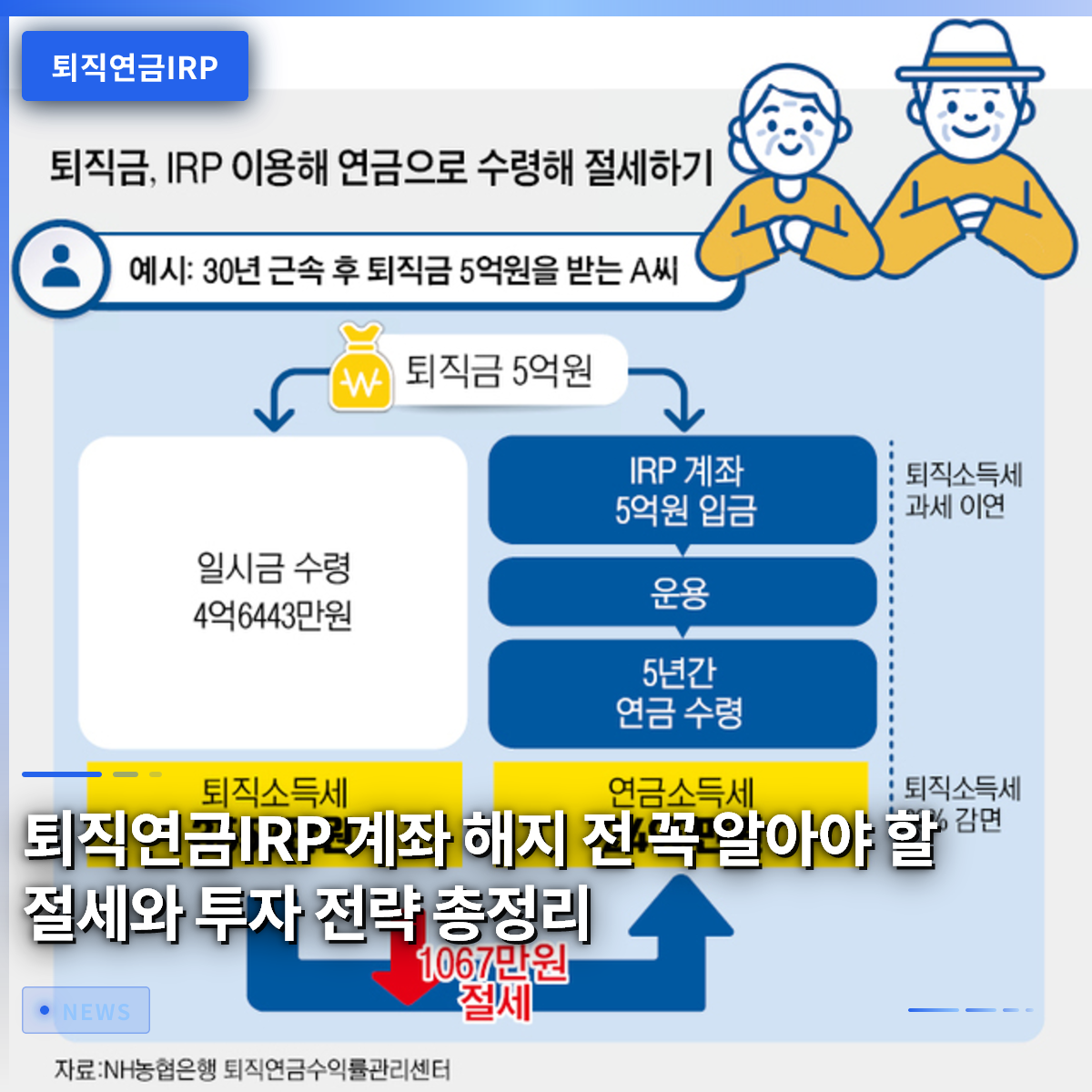
If you treat your Individual Retirement Pension (IRP) account as a simple account for withdrawing a lump sum and close it carelessly, you could face a massive tax burden. When changing jobs or retiring, if you receive your valuable severance pay directly into a regular bank account, you must pay the full severance income tax. Therefore, it is essential to transfer the funds to an IRP account. In fact, over the past few years, many people have closed their accounts midway, citing the need for funds after retirement, and ended up paying regrettable taxes. However, by maintaining this account and receiving the funds as a pension, you can significantly reduce taxes while also securing your retirement assets stably. Recently, the range of products available for direct investment through this account has expanded, offering much more diverse options. In this article, we will take a detailed look at the most prudent asset management strategies to protect your severance pay and save on taxes.
=
Essential Tax-Saving and Investment Strategies to Know Before Closing Your IRP Retirement Account
1. Why You Should Receive Your Severance Pay in an IRP Instead of a Regular Account

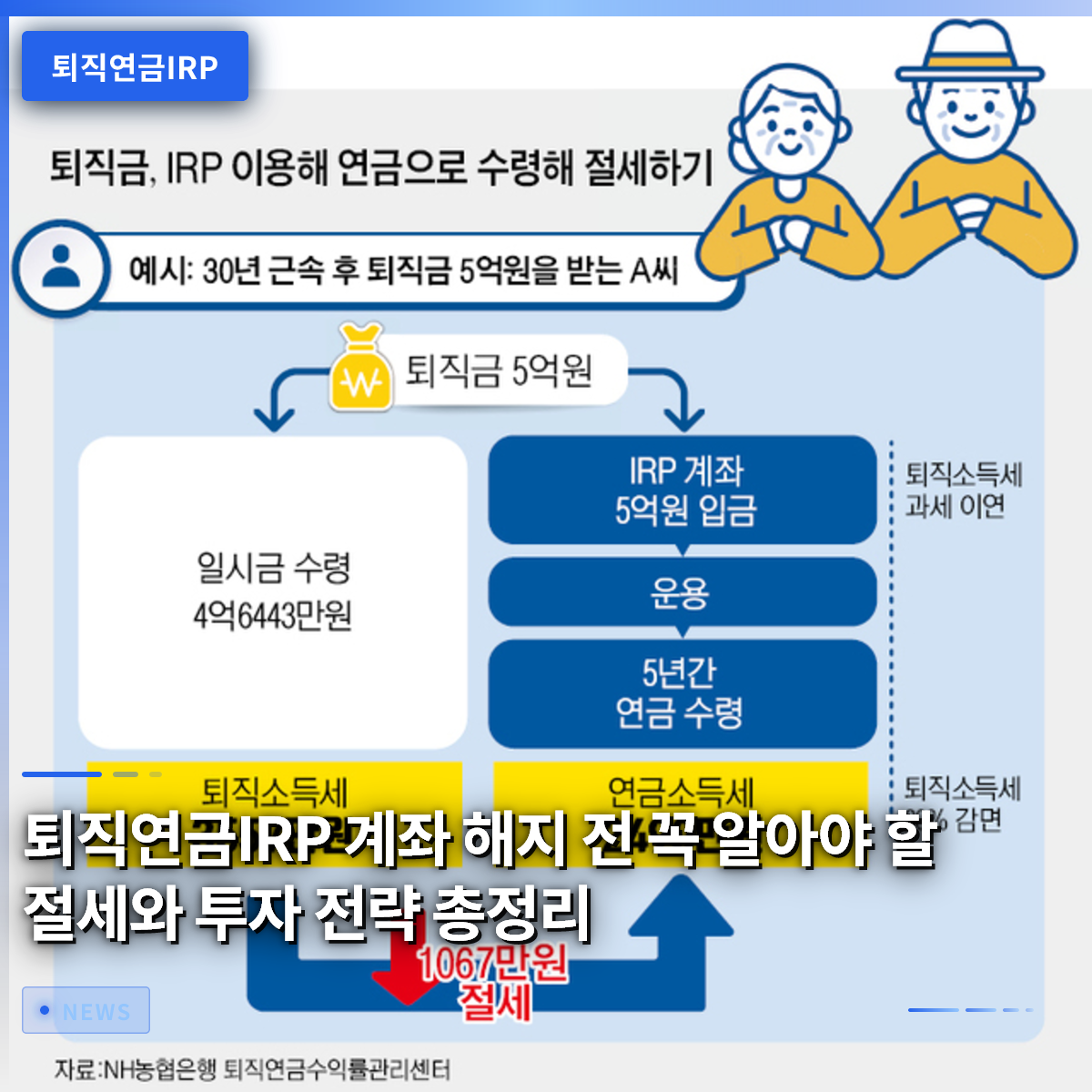
By law, the severance pay paid by a company upon resignation should be deposited into the employee’s designated Individual Retirement Pension (IRP) account in their own name. If this is ignored and the company arbitrarily deposits the severance pay into a regular personal account, you will receive no tax benefits and must pay the tax withheld at source. Since severance income tax is levied the moment you receive the lump sum, the actual amount received is often significantly less than expected.
On the other hand, if you transfer your severance pay entirely to an IRP account, you can enjoy tax deferral benefits without paying taxes immediately. The deferred taxes are postponed until you receive the pension after retirement, allowing you to grow your principal through interest or dividend income in the meantime. Therefore, the first hurdle when leaving a company is to accurately open this account and submit the account number to your employer.
It is no exaggeration to say that the success or failure of your retirement life depends on how you initially receive and manage your severance pay. Just because colleagues received their pay in regular accounts and spent it all, following suit could lead to significant financial trouble in your old age. The first step in saving taxes and protecting your assets is unconditionally transferring your severance pay to an IRP account.
Mr. Kim, who had worked at one company for many years before retiring, decided to close his account immediately upon receiving his severance pay to pay for an increased deposit on his rental housing. However, thanks to the advice of a bank employee, he maintained his IRP account, allowing him to postpone paying hundreds of thousands of won in taxes. This illustrates how a small difference in choice can become a decisive factor that completely changes the scale of your assets years later.
You must receive your severance pay in an IRP account, not a regular account, to defer taxes and grow your assets.
2. The Temptation to Resist: Why Closing an IRP Account Midway Is Dangerous
Statistics on retirement pensions show that many people unfortunately close their accounts midway, either before retirement or during job changes. While trillions of won have been transferred to these accounts over the years, an equally significant proportion of funds has been lost due to mid-term closures. This is often because people cannot resist the anxiety when they urgently need cash or when the stock market is volatile.
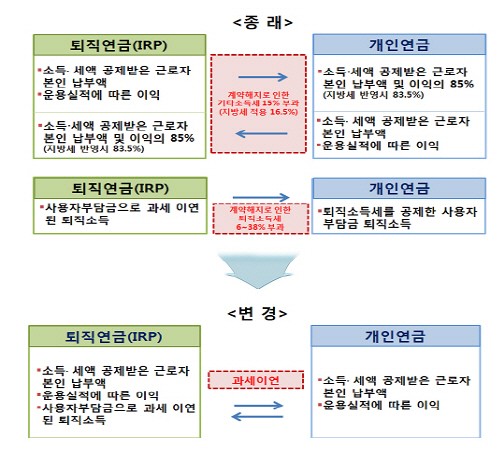
However, the moment you close the account midway, all the tax benefits you have enjoyed are lost, and a hefty miscellaneous income tax is imposed. Instead of the lower tax rate applied when receiving a pension, a much higher rate is applied, resulting in a tax bomb and a significantly reduced amount in hand. It is possible for your hard-earned retirement assets to be halved due to taxes and the penalties associated with mid-term closure.
When you urgently need a large sum of money, it is wiser to utilize exceptional withdrawal reasons permitted by law or the collateral loan system rather than closing the entire account. In unavoidable situations such as purchasing a home or securing a deposit for non-homeowners, or long-term medical treatment for oneself or family members, there are ways to access funds without closing the account. Before closing the account based on emotion, you must consult with an expert or carefully consider if there are no other alternatives.
You can easily see acquaintances who close their accounts and lock in losses out of fear when the stock market crashes. On the other hand, those who stick to their principles and maintain their assets over the long term have achieved the result of catching two birds with one stone as time passes. Since closing the account leads directly to failure, you need the tenacity to protect your account to the end, no matter what adversity comes.
Mid-term closure leads to a high tax burden and loss of retirement assets, so you should utilize exception systems first.
3. Expanded Investment Options: Utilizing Government Bonds for Individual Investors and Safe Assets
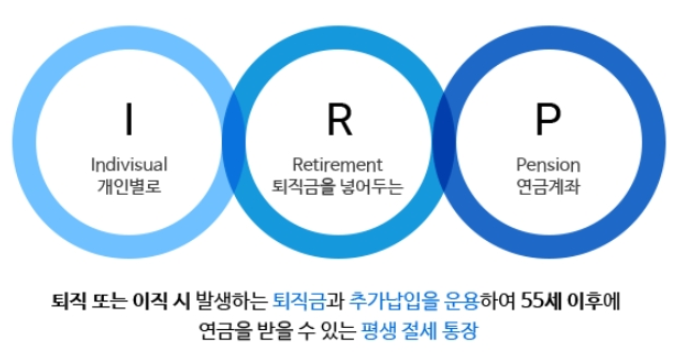
Due to recent changes in financial policy, it is now possible to directly subscribe to government bonds for individual investors, which are guaranteed by the state, in both IRP and Defined Contribution (DC) accounts. Long-term government bonds, such as 10-year or 20-year bonds, have become a new option in investment portfolios that were previously focused on equity products or deposits. The minimum investment amount has also been lowered to a reasonable level, allowing for safe diversified investment in small amounts without needing to put all your severance pay in at once.
Additionally, when managing retirement assets, regulations require maintaining a certain proportion of safe assets, so it is important to fill this wisely. By appropriately combining various bond-mixed products and stable government bonds, you can grow your assets comfortably even in highly volatile market conditions. For investors who were anxious about putting all their money into the scary stock market, the inclusion of government bonds is like a drop of water in a drought.
Government bond investment can be expected to yield stable interest income if held until maturity, making it perfect for designing cash flow after retirement. At the point when monthly income stops, the interest and principal guaranteed by the state can serve as a strong support. The most reliable weapon for employees to protect their assets after retirement while defending against inflation is this direct government bond investment feature.
Mr. Park, an employee nearing retirement, moved all his assets to safe government bonds after experiencing the thrill and fear of stock market fluctuations. Seeing the interest accumulate stably without monthly stress, he regretted not knowing about such products sooner. He personally realized that the quality of retirement life changes completely depending on how the portfolio is structured.
You can directly purchase 10-year and 20-year government bonds in your IRP account, enabling safe long-term investment.
4. Maximizing Tax Deduction Limits and Increasing Year-End Tax Refunds
For employees, voluntarily contributing to an IRP account is a highly beneficial product that returns significant tax deduction benefits during the year-end tax settlement. Since deductions can be received up to a certain limit when combined with existing pension savings products, it has become an essential financial item that employees must fill. The joy of receiving a tax refund ranging from hundreds of thousands to millions of won at year-end by depositing a little each month is a great source of vitality in working life.
To maximize the tax deduction limit, it is advisable to set up automatic monthly transfers of an appropriate amount, considering your salary level and contribution capacity. Trying to deposit a lump sum hastily as the year ends can burden your cash flow, so a strategy of consistent installment payments from the beginning of the year is advantageous. Not only do you get a tax refund, but reinvesting that money to enjoy compound interest effects accelerates asset growth beyond imagination.
Many young professionals misunderstand that pension products are only for the elderly, missing out on good tax-saving opportunities. The total assets of those who join early in their youth and consistently take advantage of tax benefits versus those who do not will show a huge gap over time. Refusing the tax-saving benefits legally supported by the state is no different from inviting a loss.
An employee who used to envy the tax refunds received by colleagues every year-end tax season decided to actively fill the tax deduction limit starting this year. After experiencing that the money saved little by little from their salary returns as a generous bonus at year-end, they strongly recommend it to those around them. A small change in habit works magic by making the bank account balance substantial every year.
Consistently contributing each year to fill the tax deduction limit allows you to enjoy strong refund benefits during the year-end tax settlement.
5. Maximizing Returns Through Non-Face-to-Face Conversion and Fee Reduction
Fees paid to financial institutions are like invisible thieves that erode returns during long-term investments, so they must be managed meticulously. In the past, accounts were created and managed by visiting counters directly, causing unnecessary asset management fees to leak out every year. However, recently, it is possible to easily convert to or open new non-face-to-face accounts via mobile apps, significantly reducing fees.
For example, using a non-face-to-face dedicated account when managing assets above a certain amount is often more than 50% cheaper in fees compared to counter transactions. Given the nature of long-term accounts that must be maintained for over a decade, this small fee difference becomes an enormous amount difference by the time you reach retirement. By tolerating the slight inconvenience of not meeting bank staff directly, you can protect your valuable assets as they are.
If the fee structure of your existing securities firm or bank is burdensome, you can switch to an institution with lower fees using the in-kind transfer system. You can move your existing stocks or funds to another financial institution in their current state without closing the account and converting to cash, so there are no tax disadvantages. Since fee policies vary widely among institutions, regularly comparing them and moving to the most advantageous one is the secret of expert investors.
An employee who visited a bank branch to inquire about fees learned that switching to non-face-to-face could save significant costs and immediately completed the conversion via mobile. They had the pleasant experience of seeing their account return rate rise slightly even while doing nothing, as the annual fees decreased. Just as a grain of sand builds a mountain, minor cost savings are the key to determining the success or failure of long-term investment.
Utilizing non-face-to-face account conversion and the in-kind transfer system allows you to save on unnecessary fees and increase returns.
6. Strategies for Retirement Planning: Starting Pension Receipts and Reducing Tax Burden
When the time comes to receive your retirement pension as retirement approaches, it is much more advantageous to receive it in installments as a pension rather than as a lump sum. Receiving a lump sum imposes a large tax burden at once, whereas converting to a pension reduces the tax at a much lower rate. Moreover, the longer the pension receipt period, the lower the applicable tax rate, allowing you to maximize the benefits provided by the state.
Wisdom is needed to flexibly adjust the age at which you start receiving the pension and the receipt period to match your post-retirement cash flow plan. You can increase the receipt amount during the gap period immediately after retirement when there is no income, and reduce it later when other income sources appear. By establishing such a systematic pension receipt strategy, you can secure stable living expenses for life while completely escaping the risk of a tax bomb.
As the aging society deepens, the importance of securing stable retirement funds will be emphasized beyond doubt. The government is also continuously introducing various tax benefits and new investment products to alleviate citizens’ retirement anxiety. Only those who accurately read these trends and prepare one step ahead of others can welcome a prosperous retirement life.
A mandatory retirement employee, with retirement just around the corner, is enjoying a leisurely life by receiving stable monthly payments like a salary, thanks to a thorough pension receipt plan. The secret to traveling leisurely while friends around them worry about how to manage their lump sum lies in thorough prior preparation. We hope you will also check your account now and start a solid plan for your future.
You should receive your retirement pension in installments rather than as a lump sum to reduce taxes and enjoy a stable retirement.
Frequently Asked Questions
=