
Recently, major indices in the New York stock market have shown widespread weakness, heightening investor anxiety. Amid rising U.S. Treasury yields and soaring international oil prices, a growing debate on slowing down the pace of the artificial intelligence industry has dealt a significant blow to semiconductor stocks. In particular, SK Hynix American Depositary Receipts (ADRs) fell sharply, while the shares of major semiconductor companies such as Micron Technology and NVIDIA also declined in succession. This market plunge is not merely a correction but the result of simultaneous caution regarding macroeconomic indicators and the growth potential of the technology sector. Market volatility is expected to increase further depending on the outcomes of the upcoming Federal Open Market Committee (FOMC) meetings. This article will examine in detail the background of these complex negative factors and their impact on the market.
=
Analysis of Causes Behind the New York Stock Market Decline, SK Hynix’s Sharp Drop, and Rising Interest Rates and Oil Prices

1. Surge in Treasury Yields and Market Shock

The sharp rise in U.S. Treasury yields was the primary cause of this stock market decline. The 10-year U.S. Treasury yield, which serves as a benchmark for global financial markets, crossed the 5 percent mark intraday, causing market tension. A 10-year yield in the 5 percent range is the first time since October 2023 and is historically rare. Although the rise has partially receded, it has placed significant psychological pressure on market participants. High interest rates increase corporate funding costs and reduce the attractiveness of the stock market. As funds shift to safe assets like bonds, the outflow of capital from risky assets like stocks has accelerated.
Such a rapid rise in Treasury yields is evidence that inflationary pressures are not easily subsiding. Indicators gauging the direction of central bank monetary policy have recorded figures higher than market expectations, freezing investor sentiment. Stock investors are growing concerned that sustained high interest rates could slow corporate earnings. Indeed, selling pressure centered on growth and tech stocks has fueled the index decline. Experts agree that it is difficult to expect stability in the stock market unless volatility in the bond market subsides. Consequently, the prevailing analysis is that the timing of a stock market rebound will inevitably be delayed unless interest rates stabilize first.
The U.S. 10-year Treasury yield breaking through 5 percent has increased corporate funding burdens and dampened investor sentiment.
2. Rising International Oil Prices and Inflation Concerns

The upward trend in international oil prices is also a key factor dampening the stock market. Geopolitical instability in the Middle East and news of the closure of a key Saudi Arabian pipeline have heightened concerns about oil supply disruptions. Both Brent crude and West Texas Intermediate (WTI) futures prices have risen, adding to energy cost burdens. Since rising oil prices directly impact not only manufacturing but also overall price indicators, market caution was high. The fear that inflation may resurface leads to pressure on central banks to raise interest rates further.
However, oil prices partially gave back their intraday gains after U.S. President Donald Trump made remarks suggesting the possibility of negotiations with Iran. Nevertheless, the unstable supply and demand situation in the oil market remains a powder keg that could push prices up again at any time. Rising energy prices increase corporate production costs, which directly translates to higher consumer prices. If consumers tighten their spending, a vicious cycle of declining corporate sales and profits may repeat. Stock market experts are urging careful monitoring of oil price trends and risk management regarding energy price fluctuations.
International oil prices have risen due to concerns such as pipeline closures, stimulating inflation and increasing pressure on central banks.
3. AI Slowdown Theories and the Hit to Semiconductor Stocks

The debate on slowing down the pace of the artificial intelligence industry, which has driven the market until now, has surfaced. Skepticism has emerged that AI-related investments are progressing too rapidly and that it is difficult to generate substantial returns in the short term. This atmosphere became the spark that instantly dragged down the stock prices of semiconductor-related stocks. SK Hynix ADRs plunged by more than 7 percent, and major tech stocks like Micron Technology and NVIDIA collapsed in unison. The shares of major semiconductor companies such as Broadcom, Intel, and AMD also fell sharply without exception.
The Philadelphia Semiconductor Index as a whole plunged by more than 5 percent, signaling a red light for semiconductor-centric investment strategies. Investors have begun to take seriously the controversy over the overvaluation of AI-related stocks that had risen sharply. At a point just before earnings announcements, excessive expectations have turned out to be a boomerang. Voices are growing that the pace of technological development and the return on investment ratio need to be re-examined. Since the semiconductor industry is highly sensitive to the economic cycle, this deterioration in investor sentiment could slow stock price recovery for the time being.
Concerns about overheating in the AI industry and calls to slow down have led to a sharp decline in semiconductor stocks, including SK Hynix.
4. Tension Ahead of the FOMC Meeting
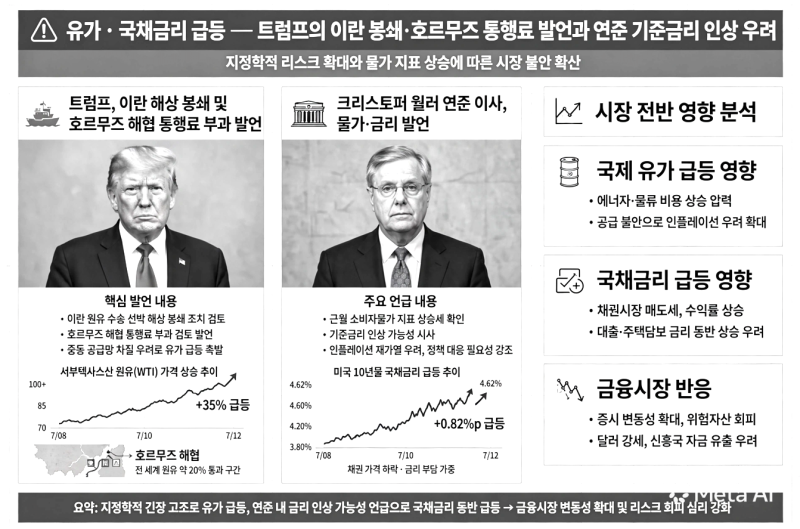
Tension in financial markets has reached its peak ahead of the imminent Federal Open Market Committee (FOMC) meeting. Market participants are closely watching what monetary policy message the central bank will send at this meeting. Concerns that inflationary pressures may intensify again due to simultaneous rises in Treasury yields and oil prices have heightened the burden on the meeting. The interest rate futures market has reflected a high probability of a rate hike at this meeting, reflecting anxiety. If the central bank, for which price stability is the top priority, maintains a hawkish stance, the market could face additional shocks.
Investors are paying attention not only to the meeting results but also to changes in the dot plot, which contains future interest rate projections. Expectations for the stock market have been dampened as forecasts suggest that the timing of rate cuts may be pushed back significantly. The market continues to react sensitively to every remark by senior central bank officials. Volatile market conditions are likely to persist until uncertainty is resolved. Therefore, it is a time when wisdom is needed to manage risk by adjusting cash ratios rather than making reckless investments.
Inflation concerns and the possibility of a rate hike ahead of the FOMC meeting have heightened market tension.
5. Stock Price Trends and Background of Major Tech Companies

Amid this stock market decline, the stock price movements of individual tech companies were particularly painful. NVIDIA’s stock price fell by more than 3 percent amid concerns over slowing demand for AI chips. Micron Technology, a memory semiconductor powerhouse, also recorded a drop of over 5 percent, showing signs of instability. Broadcom and AMD, which cover telecommunications equipment and semiconductor design, also failed to avoid significant corrections. Intel also saw a large drop in stock price, coinciding with sluggishness in the traditional PC and server markets.
Since these companies have been the main drivers of the stock market’s rise, the impact of the decline was felt even more acutely. Even if there are no major issues with earnings themselves, the deterioration of the macroeconomic environment and weakened investor sentiment have dragged down stock prices. The market has reconfirmed that it is difficult to withstand the pressure of macro variables like interest rates and oil prices, even if earnings back them up. The earnings guidance to be released by major companies in the future will be a crucial turning point in determining the direction of stock prices. Investors should calmly examine the essential competitiveness of companies rather than reacting emotionally to short-term stock price fluctuations.
Major semiconductor companies like NVIDIA and Micron fell in tandem, unable to withstand macroeconomic pressure.
6. Future Market Outlook and Investor Response Strategies

As the New York stock market has undergone a significant correction due to short-term negative factors, future response strategies have become crucial. It is safer to watch the market from a conservative perspective until movements in interest rates and oil prices find stability. In particular, since the market’s expectations for the growth speed of the AI industry have lowered, portfolios should be restructured focusing on high-quality stocks with proven earnings. A strategy of entering the market after confirming that volatility has subsided is more advantageous than premature buying at low prices.
It is essential to consistently track the release of macroeconomic indicators and the direction of central bank policy. The higher the uncertainty, the more thoroughly asset allocation should be managed and the more focus should be placed on risk management. This correction can also be interpreted as a process for the market to cool down overheating and build healthy resilience. From a long-term perspective, the direction of technological innovation will not change, so it is advisable to have patience and watch for opportunities. We hope you will wisely overcome the current market crisis with thorough analysis and cool-headed judgment.
A conservative approach and a portfolio restructuring focused on earnings are required in a highly volatile market.
Frequently Asked Questions
=